
Editor's Review
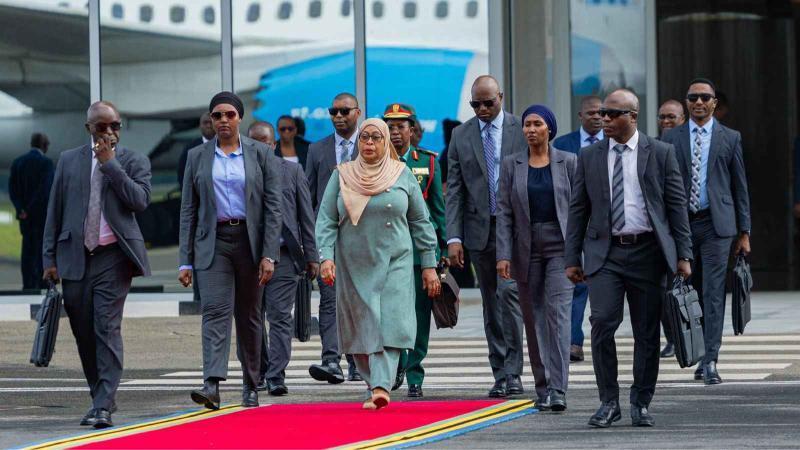
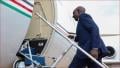
President Samia Suluhu Hassan has arrived in Moscow, Russia, for a three-day state visit, marking the first visit by a Tanzanian president to the country in more than five decades.
President Samia Suluhu Hassan has arrived in Moscow, Russia, for a three-day state visit, marking the first visit by a Tanzanian president to the country in more than five decades.
The visit comes after an invitation from Russian President Vladimir Putin and is expected to focus on strengthening diplomatic, trade, and investment ties between the two countries.
"The President is expected to hold official bilateral talks with the President of the Russian Federation, Vladimir Vladimirovich Putin.
"The two leaders will then issue a joint press statement on Wednesday," a statement issued by the Director of Presidential Communications, Bakari Machumu, said.
During her stay in Russia, Suluhu is also scheduled to receive an Honorary Doctorate Degree (Honoris Causa) from Peoples' Friendship University of Russia (RUDN University).
Read More
Economic cooperation is expected to feature prominently throughout the visit, with Suluhu set to participate in a plenary session during the 29th St Petersburg International Economic Forum (SPIEF 2026), where Tanzania hopes to attract more foreign investment and advance the implementation of Vision 2050.
Accompanying the president are several senior government officials, including Minister of State in the President’s Office responsible for Planning and Investment, Prof Kitila Mkumbo, alongside Tanzania Investment and Special Economic Zones Authority (Tiseza) Director General Mr Gilead Teri.

According to Bakari, Tanzania is expected to use the international forum to promote investment opportunities and strengthen trade relations by engaging global investors, business executives, and policymakers.
Additionally, investment promotion efforts will continue at the Tanzania-Russia Business Forum, where business leaders from both countries are expected to explore potential partnerships and commercial opportunities.
The trip carries historical significance as it becomes only the second official visit to Moscow by a Tanzanian head of state since independence.
The previous visit was made by founding president Julius Nyerere in 1969.
Nyerere’s trip took place during a period when Tanzania was actively pursuing stronger relations with socialist countries while maintaining a policy of non-alignment amid Cold War tensions.
Arriving in Moscow in October 1969, Nyerere participated in several ceremonial activities, including laying wreaths at Lenin’s Mausoleum and the Tomb of the Unknown Soldier, reflecting the importance Soviet leaders attached to relations with Tanzania.
His visit also included tours of Soviet industrial and scientific exhibitions, where Tanzania’s delegation observed Soviet advancements in agriculture, technology, industry, and space exploration.
After several days in Moscow, Nyerere traveled to Leningrad, now known as St Petersburg, where he visited historically significant sites including the Smolny Institute, the Cruiser Aurora, and Saint Isaac’s Cathedral.
Politically, the visit reinforced Tanzania’s foreign policy approach of engaging multiple global partners while maintaining independence in international relations.
-1768823097-sm.jpg)