
Editor's Review
President William Ruto has revealed how much the Standard Gauge Railway (SGR) is generating from both freight and passenger services.
President William Ruto has revealed how much the Standard Gauge Railway (SGR) is generating from both freight and passenger services.
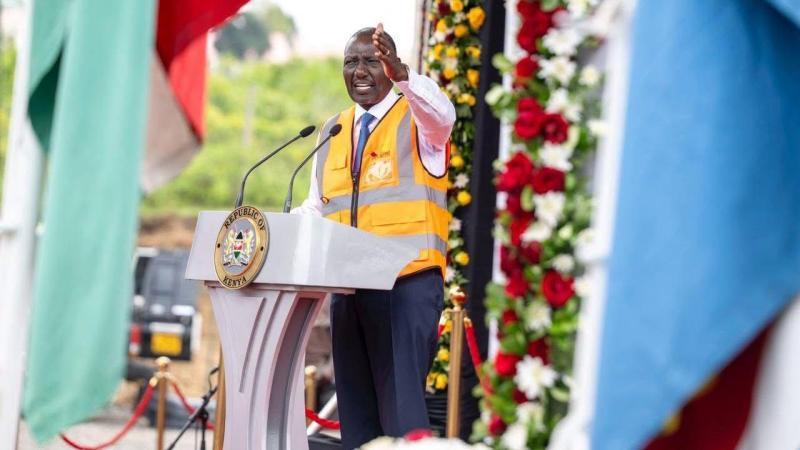
Speaking on Thursday, March 19, Ruto provided details on monthly and annual earnings, highlighting the growth in passenger uptake alongside freight operations.
"Today, SGR freight operations generate more than Ksh1.3 billion every month. Passenger revenue has grown by about 40%, surpassing Ksh4 billion annually," he said.
Ruto pointed to recent figures, particularly from December 2025, as proof of the railway’s rising performance.
"In December 2025 alone, passenger revenue reached Ksh602 million. These numbers are clear evidence of a modern railway that is working and delivering for our economy," he added.
Read More
Meanwhile, Ruto addressed the need to extend the SGR to Western Kenya, explaining why the current railway line remains incomplete.
"A railway that terminates at Narok is, by definition, incomplete. This is because it does not reach the major production zones of Western Kenya; it does not connect with the lake transport ecosystem in Kisumu; and it does not capture the full volume of outbound freight that sustains a modern rail economy," he stated.
Ruto also pointed to the increasing demand for efficient transport, citing cargo volumes through the Port of Mombasa.
"At the same time, demand for efficient transport is rising rapidly. Transit cargo through the Port of Mombasa reached 7.37 million tonnes in just six months of 2025, with nearly 70% destined for Uganda," he further said.

Ruto pointed out inefficiencies in the current transport system, noting that long transit times are hurting the country's competitiveness in the region.
"Yet today, cargo still takes up to 80 hours from Mombasa to Malaba, and over 100 hours to Kampala. A slow transport corridor inevitably loses business and weakens our competitiveness as a nation," he noted.
Ruto explained that the planned Narok-Kisumu section of the SGR is intended to address these challenges and boost economic activity across multiple counties.
"It is this gap that makes the 262.3km Narok-Kisumu section, Phase 2B of our SGR network, not just an extension, but a strategic economic intervention.
"This stretch of the railway line will connect our industrial corridor in Nairobi to the agricultural heartland of Narok, Bomet, Kericho, and Nyamira counties, and ultimately the commercial gateway of Kisumu County," he explained.
Elsewhere, Ruto on Wednesday, March 18, held a meeting with Communications Construction Company as Kenya prepares for the launch of the extension of the Standard Gauge Railway (SGR).
In an update, Ruto confirmed the meeting took place at State House, Nairobi, bringing together key stakeholders ahead of the anticipated launch.
"Met China Communications Construction Company Chairman Song Hailiang, State House Nairobi, ahead of Thursday's and Saturday's launches of the extension of the Standard Gauge Railway (SGR) from Narok to Kisumu and onwards to Malaba respectively," he said.
Ruto noted that the extension of the railway line will enhance Kenya’s position as a gateway for trade in the region.
"The SGR extension will position Kenya as the regional trade and logistics hub, linking Uganda, Rwanda, Burundi, South Sudan, and the Democratic Republic of Congo to the Port of Mombasa while unlocking the economic potential of Western Kenya," he added.
In addition to boosting trade, Ruto said the railway expansion will help address long-standing transport challenges by reducing pressure on the road network.
"It will also ease road congestion by shifting bulk cargo to rail, cutting costs, saving time, and improving safety across our highways," he further said.


 (1)-1791178178-sm.jpg)