
Editor's Review
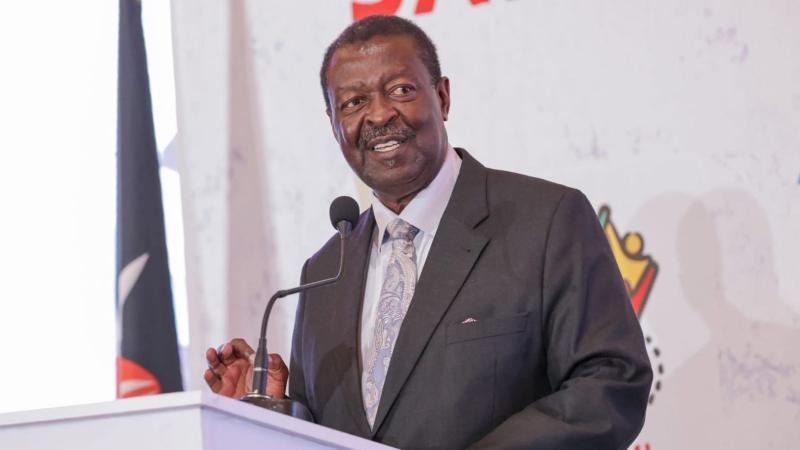
Prime Cabinet Secretary Musalia Mudavadi has warned that the country is heading toward a constitutional crisis ahead of the 2027 General Election.
Prime Cabinet Secretary Musalia Mudavadi has warned that the country is heading toward a constitutional crisis ahead of the 2027 General Election.
In a statement on Friday, December 26, he argued that unresolved electoral, population, and governance issues make a national referendum unavoidable.
Mudavadi stated that the most practical and cost-effective solution would be to conduct a referendum alongside the 2027 General Election.
"20 months into the 2027 General elections, there is a beckoning reality that 2027 is a "Referendum Moment". There is an imperative need for a constitutional review 15years after the promulgation of the 2010 Katiba," he said.
Mudavadi warned that failure to address constitutional requirements could plunge Kenya into a legal crisis that threatens the validity of the 2027 polls.
Read More
"I find it necessary to speak the truth about a looming Constitutional Storm because as a country, we are staring at a massive legal crisis; this is the potential nullification of the 2027. Our 2010 Constitution demands a boundaries review every 8 to 12 years. Our deadline was March 6, 2024. We are now in a period of constitutional non-compliance," he added.
Mudavadi further pointed to the unresolved census dispute as a critical obstacle to conducting a lawful boundary review, noting that court orders related to the 2019 census have not been fully implemented.
"Here is the catch! You cannot have a boundary review without a valid National Census. The 2019 Census was nullified in three counties (Mandera, Wajir, and Garissa). The Court ordered a “mini-census” for the three counties to be conducted by January 2026. We have not complied," he explained.
Mudavadi cautioned that attempts to merge census data from different periods would not withstand legal scrutiny, making it impossible to establish valid electoral boundaries.
"The Census Deadlock here could be a "patchwork" Census mixing the 2019 data with 2026 data, which is a legal impossibility. There will be no valid population data, therefore, no valid electoral boundaries," he further said.
Mudavadi also highlighted limitations within the Constitution that prevent fair representation in areas with rapidly growing populations.
"Notably, the Structural Bottleneck is that our population has exploded, yet we are trapped in Article. 89 (4) of the Constitution that Limited us to 290 Constituencies only. Without a ‘constitutional amendment’, the IEBC cannot give high-population areas the representation they deserve. Worse, the "protected" constituencies face extinction," he noted.
At the county level, Mudavadi said conflicting legal provisions have created a deadlock that prevents the creation of new wards to match population growth and service delivery needs.
"At the County level, there is equally a serious conflict between the 2010 Constitution that allows IEBC to name, rename, reduce or increase County Assembly Wards. But when the County Governments Act limits wards to 1450 only, we are trapped in not providing new wards to cater for the increased population and needs to have resources closer to our people," he argued.

Mudavadi stated that the accumulated legal challenges collectively justify the need for a referendum, warning that failure to act could disrupt the country's electoral cycle.
"Having noted that legal landmines may hinder the delivery of the 2027 general elections and risk the Nation departing from our longheld tradition of holding elections every five years, the following are the reasons for a beckoning reality that 2027 is a "Referendum Moment"," he stated.
Mudavadi further cited the findings of the National Dialogue Committee (NADCO), noting that bipartisan talks concluded that some issues can only be resolved directly by the people through a referendum.
"The National Dialogue Committee (NADCO), formed for bipartisan talks on electoral and governance reforms, identified issues that only the people should resolve via a Referendum. The NADCO Report identified that we must entrench the NG-CDF in the Constitution to prevent courts from threatening bursaries for our children," he said.
Mudavadi added that constitutional amendments should also introduce new development funds to strengthen oversight, devolution, and grassroots service delivery.
He further proposed formalizing key offices to promote national unity and inclusivity within government.
"I must add that we need to also introduce New Development Funds, namely, the Senate Oversight Fund. This new Fund will cater for the oversight role played by Senators under Devolution. As part of entrenching Devolution and inclusivity, I also propose the creation of the Ward Development Fund The Ward Fund is necessary for our MCAs ability to serve the electorate. It will ensure resources for water points and community halls reach the grassroots instantly
"For a Unified Face of Kenya in Government, we must formalize the Office of the Prime Minister and the Leaderbof the Official Opposition. This will ensure every region sees its face in government," he added.
Mudavadi also stated that a 2027 referendum would also provide an opportunity to finally resolve the long-standing gender representation challenge in Kenyan politics.
"In the same breath, allow me to mention that a referendum in 2027, will give us an opportunity to finally solve the riddle of the Two thirds Gender, and its compliance, not merely as a constitutional requirement but also an act ofnfairness and inclusive democracy," he concluded.
A referendum is required when proposed constitutional amendments touch on entrenched matters such as the sovereignty of the people, the Bill of Rights, the structure of government, devolution, the judiciary, or the independence of constitutional commissions.
A referendum can be initiated through two main routes: a parliamentary initiative or a popular initiative.
Under a parliamentary initiative, Parliament drafts and passes a constitutional amendment Bill.
If the Bill affects entrenched provisions, the President cannot assent to it directly and must instead refer it to the Independent Electoral and Boundaries Commission (IEBC) to be subjected to a referendum.
The popular initiative route allows citizens to drive constitutional change.
It begins with the collection of at least one million signatures from registered voters in support of a proposed amendment.
Once the signatures are verified by IEBC, the draft Bill is sent to all 47 county assemblies; if a majority of the county assemblies approve the Bill, it proceeds to Parliament for consideration.
If Parliament passes a popular initiative Bill that does not touch on entrenched provisions, it can become law without a referendum.
However, if Parliament rejects the Bill, or if the Bill concerns entrenched constitutional matters, it must be submitted to a national referendum.
Once a referendum is required, the President formally requests the IEBC to conduct it.
The IEBC is responsible for framing the referendum question, publishing it in the Kenya Gazette and the media, and organizing the vote.
For a referendum to pass, two conditions must be met; first, a simple majority of the votes cast nationally must be in favor of the proposal.
Second, at least 20 percent of registered voters must participate in the referendum in at least half of Kenya’s counties.

 (1)-1791708588-md.jpg)
 (1)-1791175033-md.jpg)
-1791699761-md.jpg)
-1791696120-md.jpg)


 (1)-1791708588-sm.jpg)
 (1)-1791175033-sm.jpg)