Editor's Review
Duale argued that the Constitution provides clear procedures for resolving national questions.
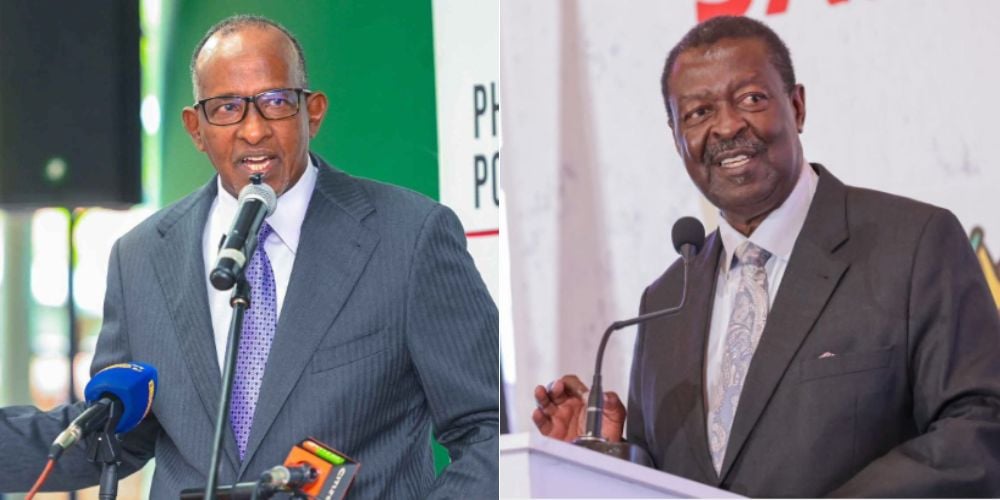
Health Cabinet Secretary Aden Duale has dismissed concerns about a looming constitutional crisis ahead of the 2027 General Election, directly contradicting Prime Cabinet Secretary Musalia Mudavadi, who recently warned that the country needs a referendum.
In a statement on Monday, December 29, Duale argued that the Constitution provides clear procedures for resolving national questions and that not every issue warrants a referendum.
The Health CS acknowledged Mudavadi's concerns but maintained that the constitutional framework remains solid and that existing legal processes are sufficient to address the issues raised.
"My Boss and the Prime Cabinet Secretary, Hon. Musalia Mudavadi, has thoughtfully drawn attention to a possible constitutional challenge that the nation could face by 2027 and has suggested that the time may be approaching for a referendum. While such calls are not new, our Constitution clearly provides procedures for resolving national questions, with the courts offering guidance whenever uncertainties arise," Duale stated.
On the contentious issue of boundary delimitation, Duale acknowledged that the Independent Electoral and Boundaries Commission (IEBC) could not act earlier because it was not properly constituted and the constitutional timeline had lapsed. However, he argued that this matter now requires guidance from the Supreme Court and IEBC rather than a referendum.
Read More
Duale further noted that issues such as entrenching development funds and implementing the two-thirds gender rule are already being addressed through ongoing legislative processes that include public participation.
"Calling for a referendum on matters currently under parliamentary consideration may inadvertently undermine these lawful processes and create unnecessary uncertainty," he cautioned.
The Cabinet Secretary emphasized that Article 255 of the Constitution clearly outlines what must be subjected to a referendum, and any proposal must first meet that constitutional standard.
"Not every issue qualifies for a referendum. Article 255 of the Constitution clearly lists what must be subjected to a referendum. Any proposal must first be tested against that constitutional standard, a process that calls for careful legal reflection," Duale stated.
He also pointed out a critical practical obstacle: Kenya currently lacks comprehensive legislation governing how a referendum should be conducted.
"Kenya currently lacks a comprehensive law governing how a referendum should be conducted. Without such a legal framework, moving toward an immediate referendum would be premature and potentially disruptive," he said.

Duale's statement comes just days after Prime Cabinet Secretary Musalia Mudavadi issued a stark warning that Kenya is heading toward a constitutional crisis ahead of the 2027 General Election.
In a statement released on Friday, December 26, Mudavadi argued that unresolved electoral, population, and governance issues make a national referendum unavoidable. He suggested that the most practical and cost-effective solution would be to conduct a referendum alongside the 2027 General Election.
"20 months into the 2027 General elections, there is a beckoning reality that 2027 is a 'Referendum Moment'. There is an imperative need for a constitutional review 15 years after the promulgation of the 2010 Katiba," Mudavadi said.
The Prime CS warned that failure to address constitutional requirements could plunge Kenya into a legal crisis that threatens the validity of the 2027 polls.
"I find it necessary to speak the truth about a looming Constitutional Storm because as a country, we are staring at a massive legal crisis; this is the potential nullification of the 2027. Our 2010 Constitution demands a boundaries review every 8 to 12 years. Our deadline was March 6, 2024. We are now in a period of constitutional non-compliance," he added.
Mudavadi highlighted the unresolved census dispute as a critical obstacle to conducting a lawful boundary review, noting that court orders related to the 2019 census have not been fully implemented.
"Here is the catch! You cannot have a boundary review without a valid National Census. We have not complied," Mudavadi explained, warning that attempts to merge census data from different periods would not withstand legal scrutiny.
Mudavadi also pointed to constitutional limitations that prevent fair representation in areas with rapidly growing populations, noting that Article 89(4) limits the country to 290 constituencies.
"Without a 'constitutional amendment', the IEBC cannot give high-population areas the representation they deserve. Worse, the 'protected' constituencies face extinction," he noted.