Editor's Review
The union outlined three key demands aimed at addressing the root causes of road accidents in Kenya.
The Transport Workers Union has issued a statement calling for urgent action to address the persistent tragedy of lives lost on Kenyan roads, particularly involving truck and bus drivers and other road users.
In a statement on Monday, January 5, the Transport Workers Union (TAWU) expressed deep concern over the systemic problem rooted in poor working conditions, unsafe commercial practices, weak enforcement, and infrastructure gaps that continue to claim lives on the country's highways.
TAWU affirmed that road safety is both a labour rights issue and a public safety issue, noting that drivers are workers whose conditions of work directly affect not only their own lives, but also the safety of passengers, pedestrians, and the wider public.
The union emphasized that road accidents are not isolated incidents but are a systemic problem that demands comprehensive solutions.
The union outlined three key demands aimed at addressing the root causes of road accidents in Kenya.
Read More
First, TAWU called for safe rates and fair working conditions for drivers. The union fully aligns itself with the International Transport Workers' Federation (ITF) Safe Rates principles, which recognize that unsafe roads are often the result of unsafe business models.
According to TAWU, underpayment, excessive working hours, unrealistic delivery schedules, and pressure from employers and cargo owners push drivers to speed, overload, and drive while fatigued or unwell.
The Safe Rates approach ensures that drivers are paid fairly for all working time, including waiting time, rest time, and delays, so that safety is not sacrificed in the pursuit of profit.
Second, the union called for the full implementation of ILO Guidelines on Road Safety and Decent Work.
TAWU supports and advocates for the complete adoption of the ILO Guidelines on the Promotion of Road Safety and Decent Work in the Transport Sector. These guidelines emphasize decent working hours and adequate rest periods, proper vehicle maintenance and roadworthiness, strong social dialogue between government, employers, and trade unions, and enforcement of occupational safety and health standards in road transport.
Third, TAWU identified infrastructure as a safety and decent work imperative. The union strongly supports ongoing and planned mega infrastructure projects, including the dualling of the Rironi-Mau Summit Road and the development and expansion of the Nairobi-Mombasa Expressway corridor.
These projects are critical in reducing congestion, driver fatigue, delays, and high-risk traffic interactions that contribute to accidents.

The timing of TAWU's statement is particularly significant given the recent spate of accidents on Kenyan roads.
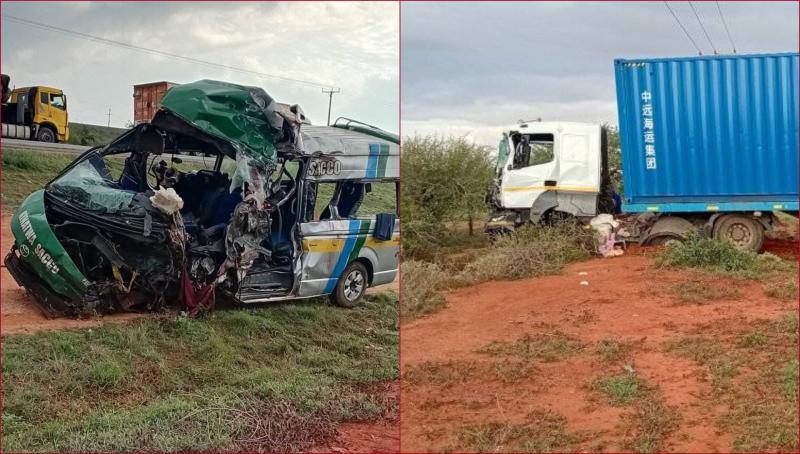
Just hours before TAWU's announcement, a deadly collision at Karai area in Naivasha along the Nairobi-Nakuru highway claimed nine lives, including two minors, when a Greenline bus collided with a 14-seater matatu belonging to Nanyuki Cabs Sacco at around 2 a.m.
Survivors of that crash accused the bus driver of reckless driving and ignoring repeated pleas from passengers to slow down despite carrying children and operating at full capacity.
"The driver was driving too fast from the word go. We tried to plead with him to slow down, because we had children on board and it was on full capacity and he refused to listen," the survivor stated.
"We ask the Greeline company to consider assigning two drivers per trip; otherwise, we will continue losing lives," one survivor urged, proposing a practical solution that could help address driver fatigue and reckless behavior on long-distance routes.
Beyond the Naivasha tragedy, Kenya has witnessed numerous fatal crashes in recent months, many attributed to driver fatigue, speeding, poor vehicle maintenance, and inadequate road infrastructure.
The Nairobi-Nakuru highway, where the latest accident occurred, has been identified as one of the country's most dangerous corridors, claiming dozens of lives annually.


 (1)-1791178178-md.jpg)


 (1)-1791178178-sm.jpg)