Editor's Review
Ahmednasir reflected on what he described as an unjust punishment and thanked senior lawyers who intervened to resolve the matter.
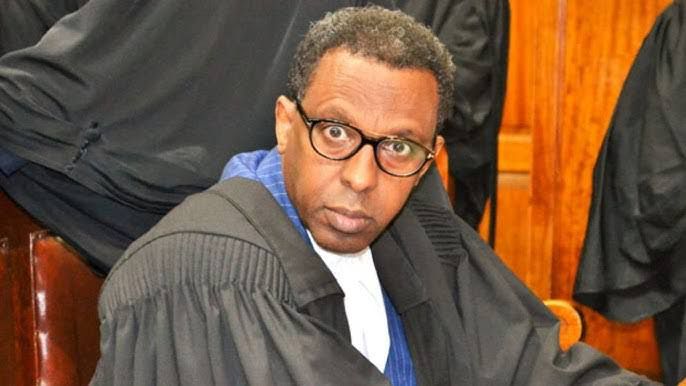
Lawyer Ahmednasir Abdullahi has welcomed a major legal victory after the Supreme Court lifted a two-year ban that had barred him, his partners, and associates from appearing before the apex court.
In a statement on Friday, January 23, Ahmednasir reflected on what he described as an unjust punishment and thanked senior lawyers who intervened to resolve the matter.
"Exactly two years ago, on 23rd January 2024, the Supreme of Kenya unfairly and without any justifiable cause banned me, my partners and associates in our law firm from appearing before the Court.
"Today, the Supreme Court lifted/vacated the said order. I thank my learned friends Paul Muite SC, Fred Ngatia SC and Dennis Mosota for the initiative they took in bringing this matter to an end. The professionalism they exhibited and their sacrifice is commendable," he said.
Ahmednasir went on to acknowledge the Supreme Court judges for recognising that their earlier action had been unfair, and for admitting that they had overreached by extending the ban to his partners and associates.
Read More
"I thank members of the Court in realising the unfairness of their action and commend them further for realising that they overreached themselves in banning my partners and associates for no reason at all," he added.
Ahmednasir then clarified that his longstanding dispute with the court has never been personal, but rather rooted in principle, ideology, and doctrine.
He stressed that lifting the ban alone does not resolve those deeper issues, which he believes require institutional reform.
"My difference with the court has never been personal. My difference with the court is principled, ideological and doctrinal. That difference remains and can't be resolved by the mere lifting of the ban. That difference can only be resolved by deep institutional reforms. I note with disappointment that the court made no promise in that regard in today's ruling," he continued.
Ahmednasir further stated that although his partners and associates are now free to practice before the Supreme Court, he himself has chosen not to return unless and until the court undertakes specific corrective steps.
He demanded that the Supreme Court openly admit that it was wrong to impose the ban, arguing that it is unacceptable for a small group of judges to effectively control who is allowed to practice before it.
"Lastly, whereas my partners and associates are now free to practice before the court, I want to make it clear that I have decided not to practice before the court unless and until the court takes the following steps/initiatives.
"The Court must admit that it was wrong in banning myself, our partners and associates. I can't go back a court where 7 men and women can decide who practices before it, the constitution of Kenya notwithstanding. The court has become the personal property of a mere 7 judges," he pointed out.

Ahmednasir insisted that the court must directly address the serious grievances and accusations he has raised against it.
He warned that lifting the ban without tackling these issues does nothing to resolve what he described as a deep legitimacy crisis facing the institution.
"The court must address the grievances I raised against it. As I said, a Supreme Court faces weighty accusations i made against it. These enormous issues of integrity and competence can't be swept under the carpet. These are issues that can't be wished away by merely lifting the ban. These issues must be addressed so that the integrity and prestige of the court is resorted to. We need to make the Supreme Court of Kenya great again. The legitimacy crisis/deficit the court suffers and which i highlighted severely persists and remains unresolved," he stated.
This comes a day after the Judicial Service Commission (JSC) concluded the recruitment and selection process for the appointment of Judges of the Court of Appeal.
Lawyer Katwa Kigen and Independent Policing Oversight Authority (IPOA) Chairperson Ahmed Issack Hassan are among the 15 nominees picked for the positions.
In a statement on Thursday, January 22, the JSC said it will transmit the names to President William Ruto for formal appointment.
"The Judicial Service Commission (JSC) has concluded the recruitment and selection process for appointment of Judges of the Court of Appeal and is in the process of transmitting the names of the nominees to His Excellency the President of the Republic of Kenya for appointment, in accordance with Article 166 (1) (b) of the Constitution of Kenya, 2010," the statement read.
JSC added that the selection process was rigorous and transparent, and it comprised advertisement of vacancies and public participation before shortlisting.
According to JSC, upon appointment, the new judges will expand the Court of Appeal, which is expected to improve efficiency in handling cases.
"Upon appointment, the additional Judges will increase the capacity of the Court of Appeal from twenty-seven (27) to forty-two (42) Judges, strengthening the Court's ability to address the existing backlog of cases and enhancing access to justice through the timely hearing and determination of appeals," the statement added.
The other nominees for the Court of Appeal include Lady Justice Hedwig Imbosa Ong’udi, Justice Mathews Nduma Nderi, Lady Justice Linnet Mumo Ndolo, Justice Enock Chacha Mwita, Lady Justice Lucy Mwihaki Njuguna, and Justice Samson Odhiambo Okongo.
Also nominated are Lady Justice Rachel Chepkoech Ngetich, Justice Stephen Andersen Radido Okiyo, Brown Murungi Kairaria, Paul Lilan, Justice Munyao Sila, Johnson Okoth Okello, and Justice Byram Ongaya.