Editor's Review
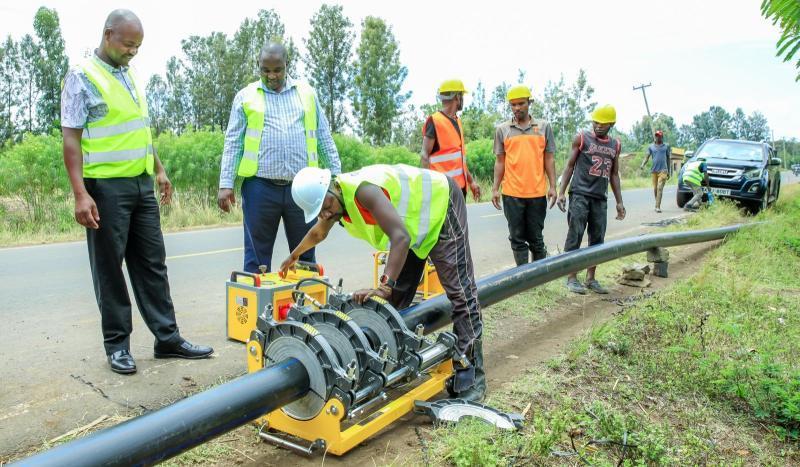
Kirinyaga County has begun laying underground high-density water pipes as part of a project aimed at supplying clean domestic water to more than 30,000 households.
The Kirinyaga County Government has begun laying underground high-density water pipes as part of a project aimed at supplying clean domestic water to more than 30,000 households in Mwea Sub-County.
Construction work is already underway to extend the Kandongu-Mutithi bulk water pipeline to villages in Mutithi Ward and Wamumu Ward.
At the same time, rehabilitation works at the Nyamindi intake have started to improve supply to parts of Nyangati Ward, Gathigiriri Ward, Tebere Ward and Thiba Ward.
According to Anne Waiguru, the county has allocated Ksh100 million for the first phase of the Mwea bulk water supply project, which seeks to expand access to clean piped water in the area.
The initiative includes extending main pipelines and feeder lines, rehabilitating water intakes, and supplying pipes and fittings to support distribution across eight wards in the sub-county.
Read More
Additional works are expected to begin on the extension of the Kutus-Kimbimbi bulk water pipeline and feeder lines to supply households in Gathigiriri, Tebere and Thiba wards.
In Murinduko Ward, the county plans to improve water access through completion of the Mugaru water project.
Waiguru also said Kangai Ward will be served through expansion of existing water lines to areas including Kombuini, Kangai and Karii.
"Once the project is completed, it will bring the percentage of residents with clean access to water to 78% in the county.Supply of clean water in the villages across the eight wards will help in reducing the burden of waterborne diseases caused through consumption commodity from unsafe sources. Investment in water infrastructure and climate-resilient is not just about pipes and boreholes, it’s about dignity, health and opportunity.
"By expanding access to clean water and empowering our communities to lead environmental action, we are laying the foundation for a greener, fairer and more prosperous Kirinyaga," she said.
Speaking during an inspection tour of the works, County Executive Committee member for Environment, Energy, Climate Change, Natural Resources, Water and Irrigation, James Mutugi, said the project is expected to significantly improve water supply in Mwea.
"We are delighted that this project has commenced, it will ensure that all the people of Mwea get clean reticulated water. The areas have had no piped water and this will have a very big impact to the people in terms of health," he said.

Mutugi said the project has several components, including extension of the Kandongu-Mutithi and Kutus-Nyangati-Kimbimbi bulk water pipelines, rehabilitation of the Nyamindi intake and supply of pipes and fittings for distribution.
He said the rehabilitation works at the Nyamindi intake are intended to increase water volumes along the Mwea-Makima system.
"It is also aimed at increasing the water volume along the Mwea-Makima water project so that once the main works are done, the people of Mwea are going to get more clean water volumes," he noted.
Some residents in the areas expected to benefit from the project said they have long relied on alternative water sources.
"We are very happy to get this water project close to us. Previously, we have been using water from wells and the canal, which is usually very dirty and full of impurities and this would make people sick. We thank Governor Anne Waiguru for keeping her word and bringing us this project," Lilian Wanjiku said.
Ndegwa Ikubu, a resident of Mugaa village in Mutithi ward, said piped water had been a long-standing need in the community.
"We have waited for this project for many years, but we are elated to finally have piped water, this will have great impact to us as we will not consume untreated water from canals again. We had become used to waterborne diseases like bilharzia, amoeba, and typhoid," he stated.
This comes monthd after Waiguru announced plans to roll out 42 new water projects with each initiative designed to serve between 300 and 500 people.
The projects will be implemented across all 20 wards in the county, with an estimated 30,000 residents expected to benefit.
According to Waiguru, the county’s program will focus on drilling and equipping boreholes with solar power, laying new water pipelines, installing storage tanks, and rehabilitating existing intakes.
She also noted that the county is simultaneously investing in environmental sustainability through the Financing Locally-Led Climate Action (FLLoCA) Program, an initiative meant to help counties and communities design and implement their own climate-resilient projects.
"Every home deserves safe water, every farmer needs irrigation support, and every child deserves to go to school without worrying about unsafe water. That is the future we are building for Kirinyaga," she said.
According to Waiguru, over the past year, the county has recorded notable achievements, completing 37 water projects such as the Kiorugari Water Project in Nyangati, the Rukenya Irrigation Project in Kabare, and the Kugeria Water Project in Murinduko.
In addition, six boreholes were drilled, with five more now underway to expand supply.
The benefits are already being felt in schools, villages, and marketplaces.
For instance, at Kamucege Primary School in Gathigiriri Ward, the borehole installed at the institution has become a lifeline for 420 learners.
"Before this borehole, learners were constantly missing school due to bilharzia and stomach infections from contaminated water. Since clean water was made available, attendance has improved and learning hours are no longer lost," said Principal Charles Weru.

 (1)-1791178178-md.jpg)

 (1)-1791178178-sm.jpg)