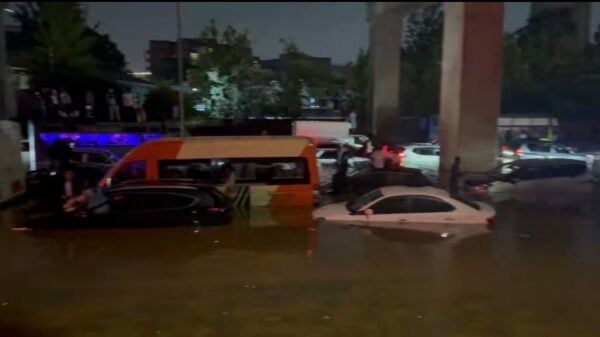
At least ten people have lost their lives in Nairobi after severe flooding hit the city on Friday night, March 6.
According to Nairobi Police Commander George Seda, eight of the victims were carried away by floodwaters.
Some of them were reportedly inside vehicles that were swept off the roads, while two additional fatalities occurred in separate electrocution incidents.
The police commander further revealed that the heavy rains left at least 71 vehicles stranded across Nairobi, as several major roads became impassable due to the floods.
According to Senator Edwin Sifuna, many could have died under the waters, though no official communication is out thus far.
Read More
"Sadly, the County disaster team has confirmed to me that multiple lives were also lost. My office has sent out teams to assess the situation and see how we can help," he said.
Meanwhile, the senator steered clear of blaming the current leadership at City Hall, noting that the entire leadership of the county at all levels ought to take responsibility.
Sifuna appreciated that the disaster is a culmination of many loopholes, regretting that Nairobians were being served to unfair realities.
"As part of the leadership in Nairobi, you will hear no excuses from me. Yesterday’s flood situation was an indictment. We know it’s a sum total of many failures, but mostly failures of leadership. We must do better because you don’t deserve this," he said.
The senator shared in the pain of those affected by the floods.
He stated that the county administration ought to thoroughly assess the existing drainage system around the city and revitalise it to match the current realities.
Sifuna condoled with those whose loved ones died in the floods.
"For all those who slept on the roads, those counting losses from the flood damage, poleni sana. Meanwhile, it is obvious that we need a comprehensive review of how the city drains because the piecemeal interventions are not working. I extend my deepest condolences to the families who lost their loved ones last night. Poleni sana," he said.

The rains began in the late afternoon, consistent with forecasts from the Kenya Meteorological Department, and continued for hours without stopping.
Nairobi’s chronic drainage problems resurfaced as the city’s system failed to manage the stormwater.
The Kenya Red Cross confirmed flooding in several areas, causing extensive damage and property loss.
Floods hit sections of CBD roads, Uhuru Highway, Mbagathi Way, Mombasa Road, Thika Superhighway, Jogoo Road, Lunga Lunga Road, Enterprise Road, and Lang’ata Road near T-Mall.
Other affected areas included Pipeline, Embakasi, Mukuru, Kibra, Mathare, Huruma, Baba Dogo, Bosnia, South B, South C, Nairobi West, Lang’ata, Umoja 3, Chokaa, Njiru, Ruai, Utawala, Roysambu, Kahawa West, Githurai, Loresho, and parts of Westlands.
In response, the Kenya Red Cross deployed teams for search-and-rescue operations.
Flooding on Uhuru Highway was particularly severe between Westlands Roundabout and University Way.
Private cars and 33-seater matatus were submerged, forcing passengers to form human chains to cross safely. Lang’ata Road and Mbagathi Way were inundated after the Mbagathi River overflowed, submerging two vehicles.
South C shopping centre, downtown Nairobi, and the road near Yaya Centre in Kilimani were also engulfed in water.
The Moja Expressway Company announced free access to the elevated road after Mombasa Road became impassable due to flooding and hours-long traffic jams.
Even residents at home were affected as floodwaters seeped inside, causing severe destruction.