
Editor's Review
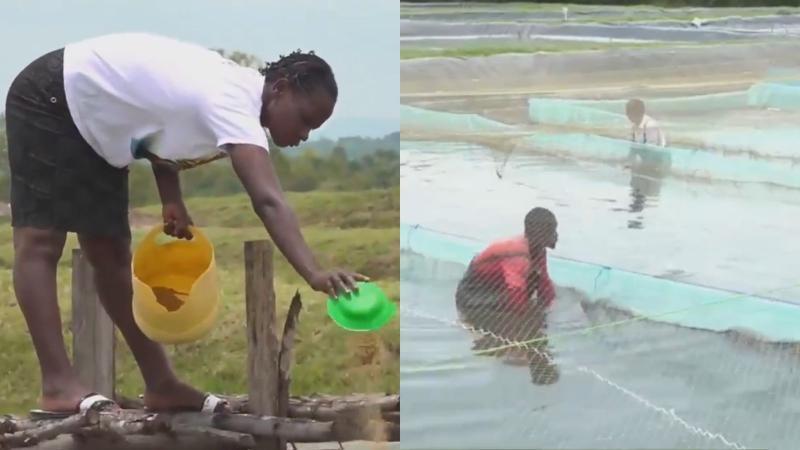
Fish farmers in Seme, Kisumu County are increasingly turning to pond farming as idle land is transformed into productive aquaculture hubs.
Fish farmers in Seme, Kisumu County are increasingly turning to pond farming as idle land is transformed into productive aquaculture hubs.
At Kosembo village in Seme, a one-and-a-half-acre site known as Kosembo Aquapark has become a lifeline for 27 residents.
Many of them were once fishermen and fish traders on the lake but were forced to abandon the waters due to harsh conditions and declining returns.
Explaining the shift, Kosembo Aqua Park chairman Samson Achola said harmful fishing practices in the lake pushed them to seek alternatives.
"At the lake, some people are using harmful fishing nets; people are struggling because those nets were catching all the fish, even the small ones. We saw that because of this, it’s better for us to come together so we can start fish ponds," he said.
Read More
For members like Eveline Awuor, pond farming has also simplified access to fish, eliminating the reliance on limited and often inaccessible supply chains.
"At the beach, there are only a few boats. So you have to know someone for them to get you fish. But here, you just come and you are given fish," she stated.
The growth of pond farming is being supported by government-backed initiatives aimed at revitalizing the aquaculture sector.
In 2024, the government commissioned the Kibos Integrated Technology Transfer Centre, a multi-billion-shilling hatchery capable of producing up to two million fingerlings every month.
The fingerlings are sold at a subsidised cost of Ksh5 each, making them accessible to small-scale farmers.
In addition, farmers receive technical support including training, water quality assessment, pond maintenance, and feeding guidance to improve survival rates and productivity.
Despite these efforts, uptake has remained below potential.

Lake Basin Development Authority (LBDA) Managing Director Wycliffe Ochiaga noted that many existing ponds remain unused.
"Pond farming over the period of time has been underutilized because we have a recent survey that indicates that only 10 percent of the ponds that have been developed have been stocked," he noted.
Despite the successes, challenges persist.
Erratic rainfall patterns have made water supply unreliable, forcing farmers to pump water from the lake, an expensive undertaking that is cutting into profits.
Achola outlined the financial strain this has placed on their operations, noting the high cost of fuel needed to sustain the ponds.
"It sometimes requires us to spend around Ksh300,000 or even Ksh400,000 on fuel. We already budgeted for the solar project, but getting that money has been a challenge, so we are requesting a partnership in case we can get one to help us further," he added.
To address such concerns and gather feedback from farmers, LBDA is planning a conference to engage the farmers and chart a way forward for the sector.
"We are organising a blue economy conference coming up in May from 7th to 9th, where we will be sharing with our fish farmers the available information. We'll be taking from them the areas that they want the government to improve on as we enhance our local fish production," he added.
The national government has also signaled strong support for the blue economy.
While laying the foundation stone for a fish landing site at Asat Beach in Kisumu County, President William Ruto emphasized the scale of planned investments in the sector.
"We are investing Ksh9.5 billion in Lake Victoria so that you can contribute meaningfully to the economy of this region, to the food security of this region, and to the economy of the Republic of Kenya," he stated.
This comes months after a section of youth in Kisumu County benefited from a new initiative that provided them with loans of up to Ksh1 million each to venture into fish cage farming.
In a statement issued on Thursday, September 11, 2025, the Youth Enterprise Development Fund (YEDF) said it had rolled out the program targeting 21 youth groups across the county.
According to the Youth Fund, the initiative was also supported by Aquaculture Barn and the Kenya Commercial Bank (KCB).
"In an effort to strengthen food security and nutrition, the Youth Fund, in collaboration with Aquaculture Barn and KCB, is enrolling 21 youth groups in Kisumu County into fish cage farming," the statement read.
The Youth Fund explained that the initiative was expected to engage about 300 young people directly, with the groups divided into two cohorts.
"The initiative directly engages about 300 youth, organized into two cohorts. Each cohort, comprising 10–11 groups, accesses up to Ksh1 million in loans to establish fish cages, rear fish, and repay the financing from proceeds after harvest and sale," the statement added.
According to the Youth Fund, the project combined financial support with training and mentorship to ensure sustainability.
"Aquaculture Barn, an innovative hub specializing in fish farmers’ training, leads mentorship and provides continuous technical support to the groups.
"YEDF facilitates market linkages, ensuring sustainable income generation and integration into the fish value chain," the statement further read.


 (1)-1791178178-md.jpg)



 (1)-1791178178-sm.jpg)