Editor's Review
The National Assembly’s Public Investments Committee on Governance and Education has raised concerns over a massive funding gap in the school feeding programme.
The National Assembly’s Public Investments Committee on Governance and Education has raised concerns over a massive funding gap in the school feeding programme.
The concerns emerged during a session on Thursday, April 2, where officials revealed that the National Council for Nomadic Education in Kenya (NACONEK) is operating far below its required budget.
The council needs Ksh8.3 billion annually to sustain its feeding initiative, but has only received Ksh1.7 billion in the current financial year, leaving a deficit of Ksh6.6 billion.
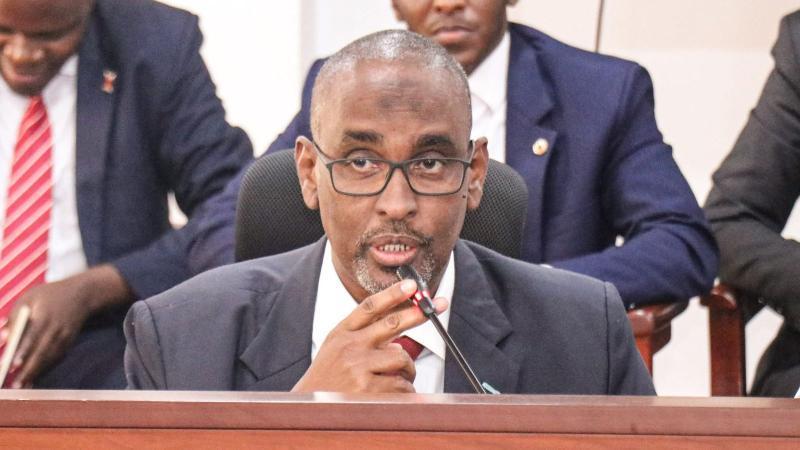
While appearing before the committee to respond to queries raised in the Auditor-General’s reports for the 2021/2022, 2022/2023 and 2023/2024 financial years, NACONEK Chief Executive Officer Harun Yussuf outlined the scale of the crisis and its impact on learners.
"We have a serious gap in the school feeding programme. The cost of feeding a child is Ksh22 per day for about 51 days, requiring approximately Ksh8.3 billion, but we have only been allocated Ksh1.7 billion," he said.
Read More
Yussuf explained that the funding shortfall has forced the council to adopt temporary measures, including scaling down meal provisions.
For now, the programme relies on providing porridge to learners as a stop-gap solution while engagements with the National Treasury continue to streamline capitation.
Beyond food provision, NACONEK is also grappling with infrastructure challenges, particularly the lack of proper kitchens in schools serving nomadic and marginalised communities.
According to Yussuf, many of the communities benefiting from the programme lack the resources to construct adequate cooking facilities.
"It is the responsibility of government to establish kitchens at school level, but we do not have the budget for that. We have only piloted clean energy cooking in six schools and are expanding to 14 more, but funding remains inadequate," he added.
Members of Parliament acknowledged the unique difficulties faced in these regions and called for a more targeted and supportive approach to ensure the programme’s sustainability.

Narok Woman Representative Rebecca Tonkei stressed that expecting impoverished communities to shoulder infrastructure costs could have devastating consequences on school attendance.
"These are very poor communities. If you ask parents in such areas to build modern kitchens, children will drop out of school. We must support them to ensure learners can eat in a clean and safe environment," she said.
Sotik MP Julius Sigei backed her position, highlighting the need for deliberate government intervention to uplift historically neglected populations.
"These are people who have been neglected for a long time. We must enhance resources to uplift them while ensuring safety standards are not compromised," he said.
At the same time, Lunga Lunga MP Chiforomodo Mangale Munga warned against lowering standards in the name of affordability, arguing that all learners deserve equal access to quality facilities.
"We should not compromise quality. These are Kenyan children and must have access to clean, modern kitchens. The council should seek more resources to meet these standards," he stated.
Kasipul MP Boyd Ong’ondo Were, who chaired the meeting, assured NACONEK that the committee would push for solutions to address both funding and operational challenges.
"This matter is before the committee, and we will make recommendations to ensure you receive adequate funding to resolve these challenges," he noted.
This comes weeks after Members of Parliament cautioned state departments under the Ministry of Water, Sanitation and Irrigation against initiating new projects in the upcoming financial year.
Speaking during the 2026 Budget Policy Statement (BPS) meeting on Tuesday, February 24, Committee on Blue Economy, Water & Irrigation Chairperson, Marakwet East MP Kangogo Bowen, warned that limited resources should be directed toward completing stalled and ongoing works.
He made it clear that the committee would not support the rollout of new projects under the 2026 BPS framework.
"You cannot spend what's not available nor stretch beyond the limits. You can't say you have a shortage of resources when you keep bringing new projects," he said.
The committee drew the line following the Ministry’s request for additional funding, part of which is expected to fund new projects.
Legislators insisted that with numerous incomplete and underfunded initiatives across the country, priority must be given to delivering existing commitments before launching fresh ones.