Editor's Review
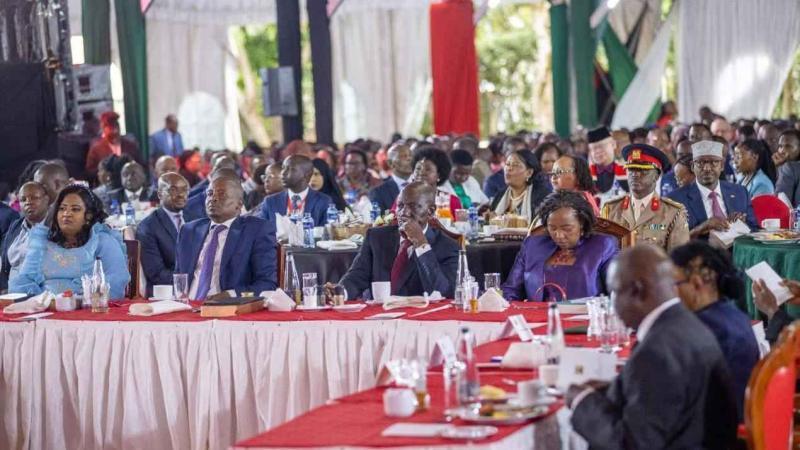
Parliament is under renewed pressure to disclose details surrounding the funding and organization of the National Prayer Breakfast.
Parliament is under renewed pressure to disclose details surrounding the funding and organization of the National Prayer Breakfast after the High Court ruled that its handling of a citizen’s request for information violated constitutional rights.
In a judgment delivered by Justice Gregory Mutai, the court found that Parliament’s conduct in responding to requests for information about the 2025 National Prayer Breakfast violated Articles 35 and 47 of the Constitution.
In a statement on Tuesday, June 2, the Office of the Ombudsman said the ruling arose from a petition filed by Lempaa Suyianka, who in March 2025 sought detailed information on the costs, funding, and organization of the annual event.
After receiving no response and later being directed to broad budget documents and audit reports, he escalated the matter to the Commission on Administrative Justice, commonly known as the Office of the Ombudsman, before eventually moving to court.
According to the Office of the Ombudsman, the court reaffirmed that access to information is a cornerstone of democratic governance and that public institutions cannot satisfy their constitutional obligations by simply directing citizens to complex technical documents.
Read More
"The Court sharply criticized the practice of referring citizens to complex budget estimates and audit reports, holding that providing technical data that laypersons cannot interrogate promotes a culture of secrecy and a lack of accountability," the Ombudsman’s office said.
The Senate, the National Assembly, and the Parliamentary Service Commission had argued that the National Prayer Breakfast was a lawful parliamentary function funded through an approved budgetary process.
They maintained that the requested information was already available in the public domain through annual expenditure estimates and Auditor-General reports.
According to the Office of the Ombudsman, the respondents also invoked the doctrine of separation of powers, arguing that the judiciary should not interfere with parliamentary affairs.
However, Justice Mutai rejected that argument, holding that courts retain the authority to intervene where constitutional rights are alleged to have been violated.
"The Court affirmed that judicial intervention is strictly warranted where there is a clear allegation of constitutional violation, thereby establishing its jurisdiction to superintend the matter," the Ombudsman’s statement noted.

While the court found that Parliament had breached constitutional obligations relating to access to information and fair administrative action, it declined to rule that public funds had been unlawfully used to finance the National Prayer Breakfast.
The judge observed that the event was financed through the approved budget of the Parliamentary Service Commission and found no evidence before the court to support claims that the expenditure was unlawful.
The judgment also cleared the Commission on Administrative Justice of any wrongdoing.
"The Court fully exonerated the 5th Respondent, the Commission on Administrative Justice, finding that it had acted with due diligence and alacrity within its statutory mandate to facilitate access to information," the statement said.
In its final orders, the court directed the Senate, National Assembly, and Parliamentary Service Commission to jointly or separately provide the requested information within 30 days.
“The Court directed that the information must be presented in a form accessible to laypeople without accounting skills," the Ombudsman’s office stated.
This comes two weeks after the Court of Appeal upheld a High Court ruling compelling the government to release documents relating to the multi-billion-dollar Standard Gauge Railway (SGR) project.
In a judgment delivered on Friday, May 15, the appellate court sitting in Mombasa dismissed an appeal filed by the Attorney General, affirming that the State's refusal to disclose documents related to the financing, procurement, construction, and management of the SGR project was unconstitutional.
"The court held that access to State-held information is a constitutional and democratic entitlement, subject only to narrowly construed and constitutionally justifiable limitations, and that the burden of proving any exemption rests squarely upon the State or public authority withholding the information," the Office of the Ombudsman said in a statement.
According to the Ombudsman, the case was filed by Khelef Khalifa and Wanjiru Gikonyo, who sought the release of extensive records linked to the SGR project, including financing agreements, procurement contracts, feasibility studies, environmental impact assessments, operational agreements, and bilateral arrangements between Kenya and China.
The petitioners argued that despite the SGR project costing more than USD 4.5 billion in public funds and loans backed by Kenyan taxpayers, critical documents had remained inaccessible to the public.
The government, through the Attorney General and Kenya Railways Corporation, had declined to release the information, citing confidentiality clauses, national security concerns, foreign relations considerations, and exemptions under the Official Secrets Act and the Access to Information Act.
The matter was later escalated to the Commission on Administrative Justice, commonly known as the Office of the Ombudsman, before proceeding to the High Court.
In May 2022, Justice Anthony Mativo ruled that the refusal to disclose the documents violated Articles 10, 35, and 47 of the Constitution and ordered the State to release the information.
However, the Attorney General challenged that decision at the Court of Appeal, arguing that disclosure would undermine Kenya’s national security, damage diplomatic relations with China, and expose the government to legal and financial consequences arising from breach of confidentiality obligations.
The court has since dismissed the Attorney General’s appeal in its entirety, upheld the High Court orders compelling disclosure of the SGR documents, and directed that each party bear its own legal costs due to the public interest nature of the case.