Editor's Review
The government has provided a progress update on the construction of the County Aggregation and Industrial Park (CAIP) in Homa Bay County.
The government has provided a progress update on the construction of the County Aggregation and Industrial Park (CAIP) in Homa Bay County.
In a statement on Saturday, June 20, Interior Principal Secretary Raymond Omollo said the project, located at Riwa in Rachuonyo Constituency, is a key component of the government's strategy to promote decentralized manufacturing and economic growth.
"The construction of the County Aggregation and Industrial Park (CAIP) at Riwa in Rachuonyo Constituency, Homa Bay County, reaffirms the Government's deliberate push to industrialize the country through decentralized manufacturing hubs under the Bottom-Up Economic Transformation Agenda (BETA)," the statement read.

Omollo noted that the industrial park is being implemented through collaboration between the national and county governments.
Read More
"Delivered through a strong Intergovernmental Partnership between the National and County Government of Homa Bay, the project is positioning the region as a key player in agro-industrial growth," the statement added.

According to Omollo, construction works have made substantial progress, with several key structures already nearing completion.
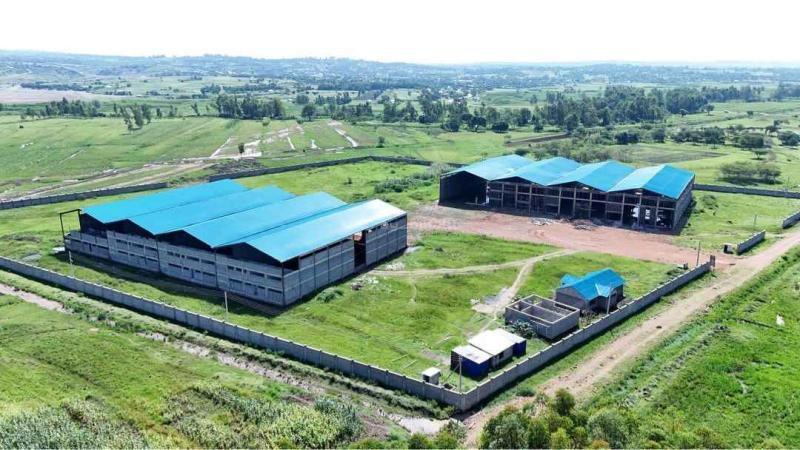
"Significant progress has already been achieved. The substructures of four warehouses are complete and awaiting final finishes, including ongoing plaster works and installation of essential amenities, while four additional warehouses are at the roofing stage. The perimeter wall is also fully constructed, securing the expansive 536-hectare site," the statement further read.

Omollo said once completed, the industrial park is expected to support processing and value addition for a number of agricultural products produced in Homa Bay and surrounding regions.
"The CAIP will support value addition across strategic value chains including cotton, pineapple, fish, oil palm, groundnuts, avocado and sweet potato; unlocking opportunities for aggregation, processing and market access," the statement noted.

Omollo also highlighted the importance of security and community engagement in ensuring the project's success and attracting investors to the area.
"To support its successful rollout, the State Department for Internal Security and National Administration is coordinating local administrative structures and security agencies to safeguard the site, facilitate seamless community engagement and ensure a stable operating environment that attracts investors and sustains industrial activity at the CIAP," the statement concluded.

This comes days after Omollo announced the completion of the Ngong Road-Naivasha Road flyover.
In an update on Thursday, June 18, PS Omollo said the flyover is now awaiting commissioning, describing the project as a major milestone in the transformation of Nairobi into a modern city.
"As part of the Government's ongoing investment in modern infrastructure and urban mobility, the Ngong Road–Naivasha Road Junction Flyover has now reached completion and is nearing commissioning, marking another significant milestone in Nairobi's transformation into a modern, efficient and globally competitive Capital City," read the statement in part.
The project features an 800-metre elevated dual carriageway designed to streamline traffic flow by separating through-traffic on Ngong Road from vehicles accessing Naivasha and King'ara roads.
Omollo noted that the flyover is expected to ease congestion by improving traffic flow and reducing travel times between Ngong and the Nairobi Central Business District (CBD).
The project is also expected to enhance access to key urban facilities, including the Talanta Stadium.
"Once fully operational, the flyover is expected to significantly ease congestion along one of Nairobi's busiest transport corridors, drastically reduce travel times between Ngong and the Central Business District and improve connectivity to key urban facilities, including the nearby Talanta Stadium ahead of AFCON 2027," he stated.
The construction of the project commenced in September 2024 and has been implemented by the Kenya Urban Roads Authority (KURA).
The project has been funded by a loan of Ksh3.58 billion from the Spanish Corporate International Fund (FIEM).


 (1)-1791178178-md.jpg)



 (1)-1791178178-sm.jpg)