
Editor's Review
The Pest Control Products Board (PCPB) has raised concerns over the growing circulation of illegal pest control products in Kenya.
The Pest Control Products Board (PCPB) has raised concerns over the growing circulation of illegal pest control products in Kenya.
In a statement on Saturday, June 20, the agency warned that the unauthorized chemicals pose significant dangers to public health, food security, the environment, and the country's agricultural sector.
PCPB said efforts are ongoing to prevent unauthorized products from entering the Kenyan market and to ensure that only approved pesticides are available to consumers.
"Unregistered pest control products pose a serious risk to human health, food safety, the environment, and agricultural productivity. Illegal pesticides are often ineffective and may contain undeclared chemicals that can cause harm.
"To address this challenge, the Pest Control Products Board (PCPB) continues to strengthen surveillance and enforcement efforts to prevent the entry, distribution, and use of unauthorized pest control products, ensuring farmers and consumers have access to safe, quality, and efficacious products," the statement read.
Read More
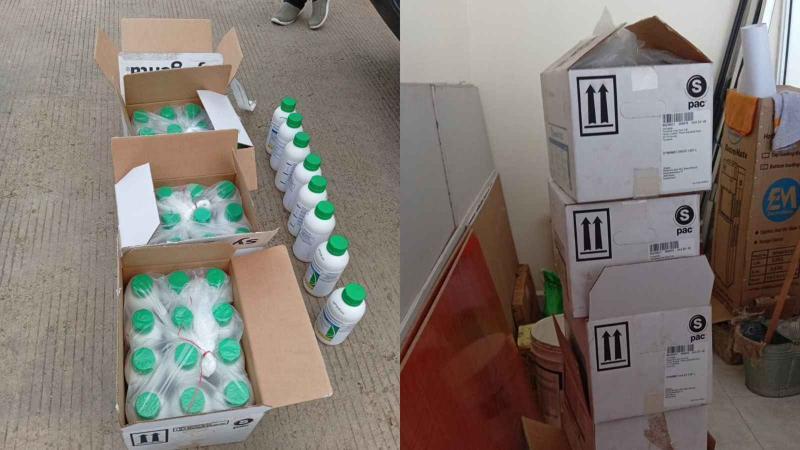
According to PCPB, the warning follows a recent operation conducted by PCPB officers at the Namanga border crossing, where smuggled pesticides were discovered during routine inspections.
"On 18th and 19th June 2026, during routine surveillance operations, PCPB officers stationed at the Namanga One Stop Border Post (OSBP), in collaboration with other enforcement agencies, intercepted consignments of unauthorized pest control products being smuggled into the country," the statement added.
The board revealed that the products had been hidden among ordinary cargo and transported through public service vehicles operating between Nairobi and Namanga.
"The products, concealed beneath sacks and transported as parcels in the luggage compartments of Impala Connections and Naekana public service vehicles operating along the Nairobi-Namanga route, were seized during operations at the OSBP and Maili Tisa Roadblock," the statement noted.

PCPB reminded all stakeholders in the agricultural value chain that only products approved by the board can legally be imported, sold, distributed, or used in Kenya.
"PCPB reminds importers, distributors, transporters, retailers, farmers, and members of the public that only pest control products registered and approved by the Board are legally permitted for importation, distribution, sale, and use in Kenya, in accordance with the Pest Control Products Act, Cap. 346," the statement further read.
PCPB further urged Kenyans to verify the registration status of pest control products before purchasing or applying them and warned that those involved in the illegal trade would face legal consequences.
"The Board urges all stakeholders to verify the registration status of pest control products before purchase or use. Any person or entity involved in the illegal trade of unauthorized products will be subject to regulatory and legal action as provided by the Pest Control Products Act, Cap. 346," the statement concluded.
This comes weeks after the Anti-Counterfeit Authority (ACA) warned farmers after a multi-agency enforcement team seized 250 bags of suspected counterfeit fertilizer in Kakamega County.
In a statement on Monday, April 20, authorities said the crackdown also involved the Directorate of Criminal Investigations (DCI), Kenya Bureau of Standards (KEBS) and the Government Chemist.
"Beyond the bulk fertilizer, investigators recovered various packaging materials and a consignment of government subsidy stock marked ‘Not for Sale,’ suggesting a sophisticated scheme to divert and repackage state-funded resources for illegal trade," the statement read in part.
ACA also raised concern over when the seizure happened, noting that many farmers are currently buying farm inputs as rains continue across several regions.
"The timing of this seizure is particularly alarming as it coincides with the ongoing rains and peak planting season," the statement added.
Kisumu ACA Regional Manager Tom Muteti said the presence of substandard fertilizer in the market poses a direct threat to crop yields and national food security.
He said farmers depend on genuine products to secure expected harvests, warning that any compromise at planting stage can have serious effects on livelihoods and the wider economy.
"The risks associated with counterfeit fertilizer extend beyond immediate financial loss, as substandard products can lead to long-term soil degradation and poor crop development. Such inputs often lack the essential nutrient balance required for healthy growth, resulting in stunted harvests that weaken the country’s overall food production capacity," the statement further read.


 (1)-1791178178-md.jpg)





 (1)-1791178178-sm.jpg)