Editor's Review
By-elections in Kenya have often served as tests of a political party’s strength and the sitting government’s support.
By-elections in Kenya have often served as tests of a political party’s strength and the sitting government’s support.
While some have attracted little national attention, others have assumed greater significance because they were held at politically consequential moments or ahead of a General Election.
There have also been occasions when parties associated with sitting presidents suffered notable defeats. Here are three such by-elections from the presidencies of Daniel arap Moi, Uhuru Kenyatta and William Ruto.
1. Kipipiri — Daniel Arap Moi, 1995
The 1995 Kipipiri by-election was one of the early electoral tests for KANU after Kenya returned to multiparty politics in 1991
Read More
The seat fell vacant following the death of MP Laban Muchemi, who had been elected on a Ford-Asili ticket in the 1992 General Election. President Daniel Moi's KANU fielded Joe Maina, while Mwai Kibaki's Democratic Party (DP) nominated Mwangi Githiomi.
Moi personally campaigned for Maina. Electricity poles were also installed in the constituency during the campaign, with media reports linking the works to promises of electricity connectivity.
The campaign efforts did not translate into a KANU victory. Githiomi won with 14,858 votes, while Maina received 3,144, giving the DP candidate a margin of 11,714 votes.
In 1996, Githiomi told the National Assembly that electricity poles had been brought to Kipipiri during the by-election and removed after KANU lost. The then Energy Minister disputed the allegation, saying the poles were part of ongoing electricity projects.
The defeat was a humiliation for KANU, which was the governing party and had been regarded as the dominant political force at the time. Its loss in Kipipiri demonstrated that the party could be defeated in a by-election, despite the involvement of the sitting president in the campaign.
The result was subsequently associated with the phrase "Moi aonja pilipili Kipipiri", meaning "Moi tastes pepper in Kipipiri."
2. Kiambaa — Uhuru Kenyatta, 2021
The 2021 Kiambaa by-election became a closely watched contest between the Jubilee Party headed by President Uhuru Kenyatta and the political camp associated with his then-Deputy President, William Ruto.
The parliamentary seat fell vacant following the death of Jubilee MP Paul Koinange in March 2021. Jubilee nominated Kariri Njama, while the United Democratic Alliance (UDA) fielded John Njuguna Wanjiku. Eight candidates contested the election, although the race largely centred on the Jubilee and UDA candidates.

The election was held in Kiambu County amid the political fallout between Kenyatta and Ruto. Jubilee was the governing party led by Kenyatta, while UDA was associated with Ruto, who was then Deputy President.
The final result was closely contested. IEBC records show that Wanjiku received 21,773 votes, defeating Njama, who received 21,263 votes; a margin of 510 votes.
The announcement of the results was delayed after the Jubilee side raised objections. Njama later indicated that he would challenge the result, citing alleged electoral irregularities.
Wanjiku's victory handed UDA the Kiambaa parliamentary seat and was a particularly significant defeat for Jubilee because it occurred in Kiambu County, Uhuru Kenyatta's home county, less than a year before the 2022 General Election.
3. Ol Kalou — William Ruto, 2026
The latest example came in the Ol Kalou parliamentary by-election held on July 16, 2026, in Nyandarua County.
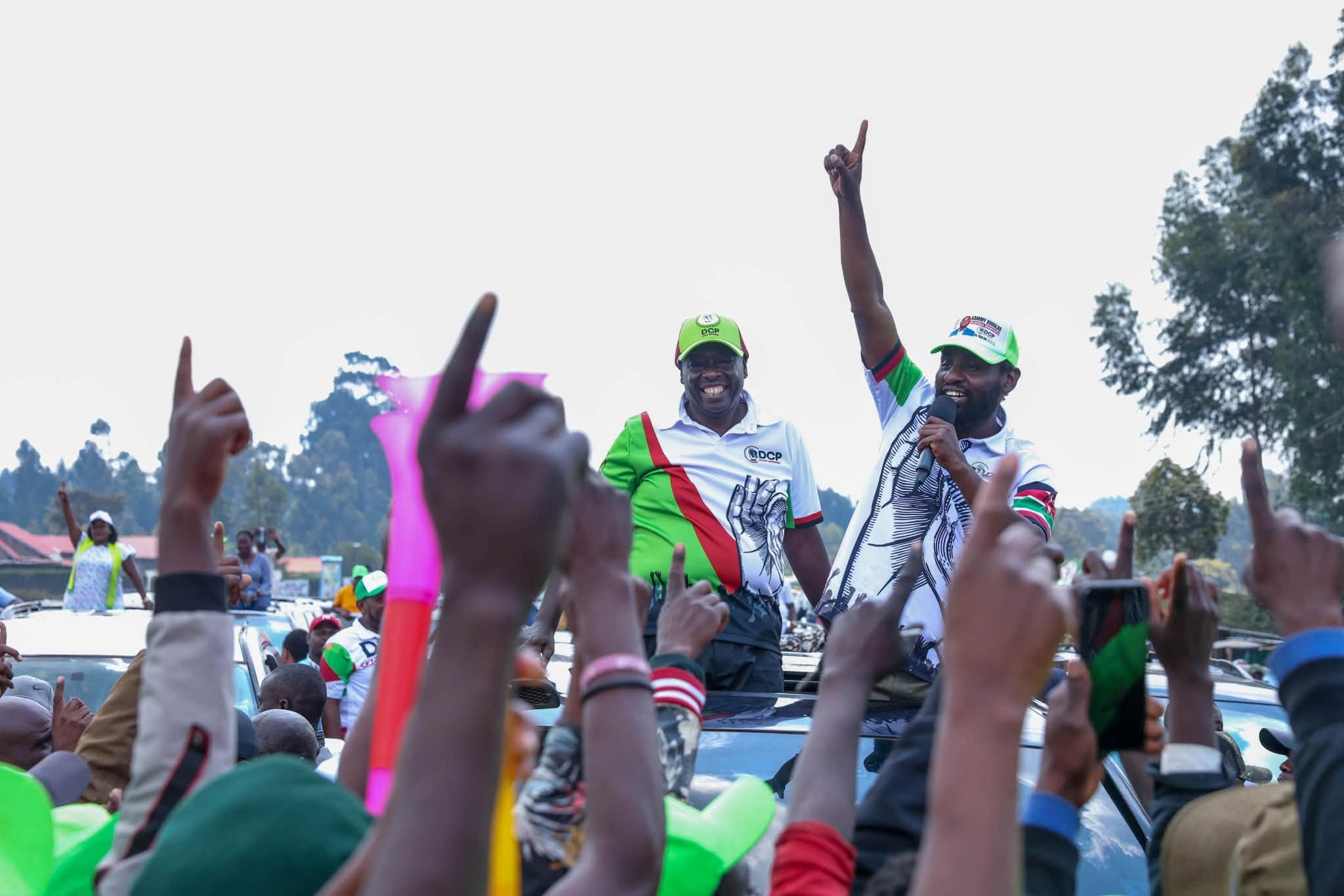
The contest featured Democracy for the Citizens Party (DCP) candidate Sammy Douglas Kamau Waweru and UDA candidate Samuel Muchina Nyagah, alongside other candidates.

UDA mounted an intensive campaign in the constituency, with Cabinet secretaries, principal secretaries, MPs and other government-aligned leaders campaigning for its candidate. Government development activities and the distribution of items including mattresses and LPG cylinders also took place during the campaign period.
Government officials described the initiatives as development programmes, while opposition leaders questioned their timing and alleged they were intended to influence voters.
The election proceeded on July 16, with the IEBC declaring DCP's Waweru the winner. Waweru received 35,440 votes, while UDA's Nyagah received 5,450 votes.
The result was a humiliation for the Ruto administration after the extensive government-backed campaign in the constituency failed to deliver the seat to UDA. It also came amid the political rivalry between President Ruto and his former deputy, Gachagua, whose DCP won the seat.
The contest had been presented by both sides as a test of political influence in the Mt Kenya region ahead of the 2027 General Election.
-1789385357.jpeg)