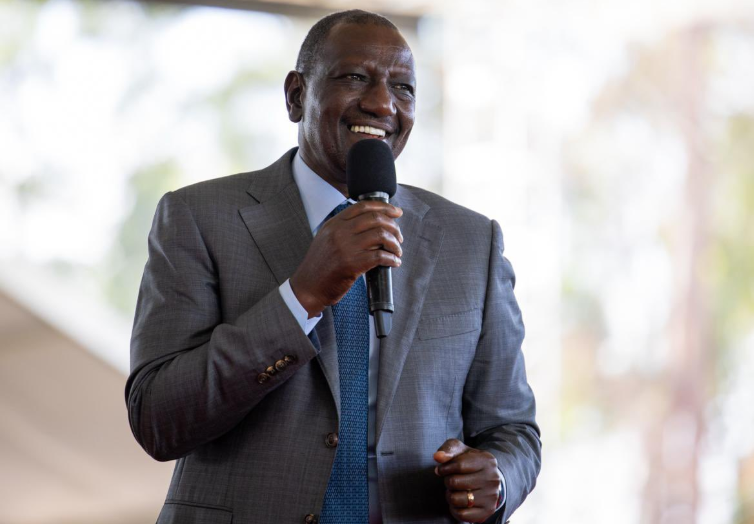
President William Ruto has announced plans to move to court to seek an advisory opinion on the place of political manifestos in Kenya.
Speaking on Wednesday, January 28, during the swearing-in of Court of Appeal judges at State House, Nairobi, the President said he would soon approach the court for clarity on how manifestos should be treated when their implementation is challenged.
President Ruto argued that the people of Kenya are the ultimate authority in the republic and they endorse manifestos while voting for their leaders.
He questioned how manifestos should be regarded after being endorsed by voters, but their implementation is contested on grounds of public participation.
“I will be in a short while, approaching the court to help me understand the place of a policy document called a manifesto. You all understand that the ultimate authority in the Republic of Kenya is the people of Kenya, and the people of Kenya speak to us through their decisions in many respects, including through their vote.
Read More
"I will want to understand when the people of Kenya vote for a manifesto, where does that manifesto stand when its implementation is challenged, sometimes on account of public participation to the detriment of millions who voted for it,” Ruto stated.

The Head of State noted that an advisory opinion from the judiciary will provide clarity on the place of manifestos in Kenya.
Further, Ruto said the country wants to change the political discourse towards policies and ideas.
“I think as we grow our jurisprudence, it’s a good thing to try and help us understand because progressively we want to move away from our political discourse being a round personalities and to move more towards policies, ideas that get captured in a manifesto upon which a government is established,” Ruto added.
His remarks come after several policies under his Bottom-Up Economic Transformation Agenda (BETA) have been challenged in court, with others being suspended.
In 2025, the courts suspended several of President Ruto’s policies, including the Compensation for Victims of Protests Committee, the Multi-Agency Team to Fight Corruption (MAT), the Electronic Government Procurement System (e-GP), and the payment of school fees via eCitizen.
On September 8, the high court issued a ruling blocking the implementation of the government's framework for compensating victims of demonstrations and public protests following a petition filed by lawyer Levi Munyeri.
This is after President Ruto appointed an 18-member panel of experts headed by Professor Makau Mutua on August 25, 2025, to facilitate compensation of victims of demonstrations and protests dating back to 2017.
On August 20, 2025, Justice Bahati Mwamuye suspended Ruto’s Multi-Agency Team on War Against Corruption (MAT) following a Petition by Magare Gikenyi, Eliud Karanja Matindi, Philemon Abuga Nyakundi, and Dishon Keroti Mogire.
“Pending the inter partes hearing and determination of the Petitioners/Applicants’ Notice of Motion Application dated 20/08/2025, a conservatory order be and is hereby issued staying the operation and implementation of, or the further operation and/or further implementation of, the ‘Presidential Proclamation on the Establishment of Multi-Agency Team on War Against Corruption’ issued under the Hand and the Seal of the President of the Republic on 18/08/2025,” Justice Mwamuye stated.
-1773894827.jpg)