Editor's Review
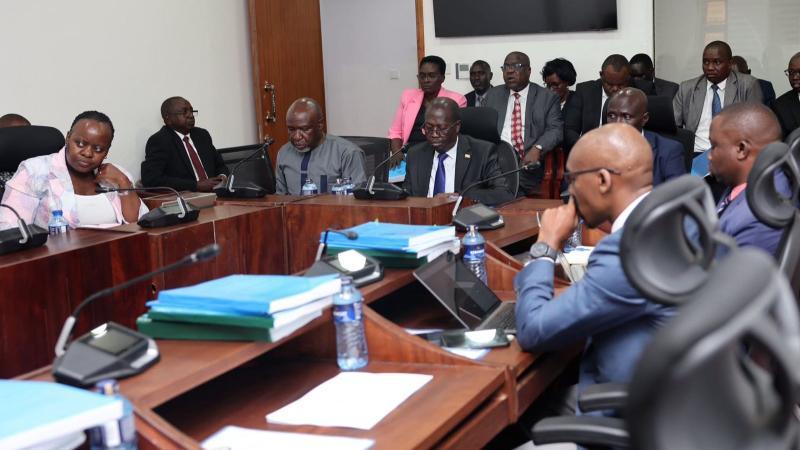
Baringo County Governor Benjamin Cheboi faced tough questions from the Senate County Public Investments and Special Funds Committee over the hiring of 730 casual health workers.
Baringo County Governor Benjamin Cheboi faced tough questions from the Senate County Public Investments and Special Funds Committee over the hiring of 730 casual health workers across public hospitals in the county.
The governor appeared before the committee on Friday, March 6, together with members of his executive team to respond to concerns raised in the Auditor General’s report for the 2024/2025 financial year.
The committee, chaired by Vihiga Senator Godfrey Osotsi, raised alarm over the county’s human resource practices after auditors established that hundreds of health workers were employed on casual terms, with some serving on repeated short-term contracts for years.
Opening the interrogation, Osotsi said the findings pointed to serious irregularities in the county’s staffing structure.
"You cannot tell us that you do not have money to pay permanent nurses when you are already paying the same nurses on a three-month basis for ten years. The money is going out regardless. The only thing you are saving is their pension and their job security. That is not a saving the law allows you to make," he said.
Read More
According to the audit report, Baringo’s hospitals have a total of 730 casual employees, with the Level 5 Baringo County Referral Hospital alone accounting for 222 casual and contracted staff, including 41 nurses.
Auditors further established that some of the technical staff have been working under renewable three-month contracts for up to ten years, a practice that contravenes the Employment Act and the County Public Service Human Resource Manual.
Responding to the concerns, Cheboi admitted the county had widely relied on short-term contracts but attributed the situation to financial pressure and the high county wage bill.
"The wage bill is a heavy chain around our neck. While we admit that the engagement of technical staff on renewable three-month contracts is widespread, we have used Facility Improvement Funds to keep these hospitals running.
"We are now working on a plan to regularize these staff through the Public Service Board, but we must balance this against our fiscal envelope," he stated.
The committee session also reviewed broader issues affecting health services in Baringo, including shortages of medical equipment and the gap between hospital classifications and the actual services offered to patients.
Osotsi noted that the Auditor General’s findings were based on physical inspections of the facilities and therefore required clear answers from the county leadership.
"Governor, the Auditor General has visited these hospitals, physically verified what is there and what is not there, and put it in writing. We are not dealing with opinions here; we are dealing with facts on the ground.
"The people of Baringo were told these are Level 4 and Level 5 hospitals. Our question today is very simple: what exactly does that mean for a patient who walks through those doors?" he added.

Cheboi defended the county’s efforts to improve health facilities but acknowledged the challenges in acquiring specialized medical equipment.
"We are operating in a complex environment where the classification of a hospital often outpaces the arrival of specialized equipment.
"At Eldama Ravine, for instance, we have finally formed an asset management committee to ensure we recognize and depreciate our assets properly, a step that was previously ignored," he further said.
The committee also heard concerns about shortages of critical equipment at Baringo County Referral Hospital.
Senator George Mbugua criticized the situation, noting that the hospital’s intensive care unit reportedly has only one functional ventilator.
"I am looking at this list, and I am asking myself: what exactly makes this a referral hospital? You have an ICU with one ventilator. You have a maternity ward that, by your own admission, is poorly equipped. Your eye care equipment breaks down, and you are waiting for parts from abroad. The upgrading of these hospitals has excited the organograms; it has not excited the patients. That is the problem," he pointed out.
Cheboi explained that placing expensive equipment in remote hospitals can be difficult because suppliers often consider patient traffic before making such investments.
"Placement of expensive equipment like MRI scanners is often a matter of business feasibility. Suppliers expect a certain level of patient traffic to recover their investment.
"In remote Level 4 hospitals like Chemolingot or Kabartonjo, where traffic is low, we struggle to attract these vendors. It is therefore a joint responsibility of the county and national government to provide essential machines where the market logic fails," he explained.
The session also touched on the waiver of more than Ksh2.2 million in hospital bills issued to patients who were not registered under the Social Health Authority (SHA), which senators said goes against the Social Health Insurance Regulations 2024.
Cheboi said the county sometimes faces difficult decisions when dealing with residents who lack national identity documents required for SHA registration.
"A significant portion of our population in Baringo lacks national identity documents, making SHA registration impossible. We are often forced to choose between strict legal compliance and the human necessity of releasing a body from the mortuary or treating an indigent patient," he further said.
This comes days after National Assembly’s Public Investments Committee on Social Services, Administration, and Agriculture (PIC-SSAA) uncovered widespread financial mismanagement and procurement irregularities at Kenyatta National Hospital (KNH), Kenya Medical Research Institute (KEMRI) and the Pharmacy and Poisons Board (PPB).
In an update on Wednesday, February 18, Parliament said the findings were presented during sessions at Bunge Tower, Parliament Buildings, where lawmakers reviewed Auditor-General’s reports for the 2022/2023 and 2023/2024 financial years.
At KNH, MPs flagged Ksh36 million in lost rental revenue even as the hospital’s Board approved a 10 per cent rent increase on decades-old residential units, some of which were earmarked for demolition.
The committee questioned the logic of increasing rent when occupancy stood at 60 per cent and income had already fallen 21 per cent below projections.
At KEMRI, lawmakers raised alarm over the disappearance of a title deed for a 2.4-hectare parcel in Nairobi valued at over Ksh4 billion.
A private developer reportedly used the title as collateral for a bank loan without evidence of authorization.
At PPB, the committee highlighted regulatory weaknesses that could expose Kenyans to substandard medicines.
The MPs recounted the case of a patient who failed to recover after receiving medication locally but improved after sourcing the same drug from Dubai.
Auditors further flagged Ksh75 million tied to headquarters land without a valid title deed at the time of audit, undisclosed land in Machakos, and Ksh5.25 million spent on vehicle repairs without mandatory inspection reports.

 (1)-1791178178-md.jpg)
 (1)-1791178178-sm.jpg)