
Editor's Review
A rehabilitation of the Nairobi Dam is set to be undertaken following a joint assessment by officials from the County Government of Nairobi.
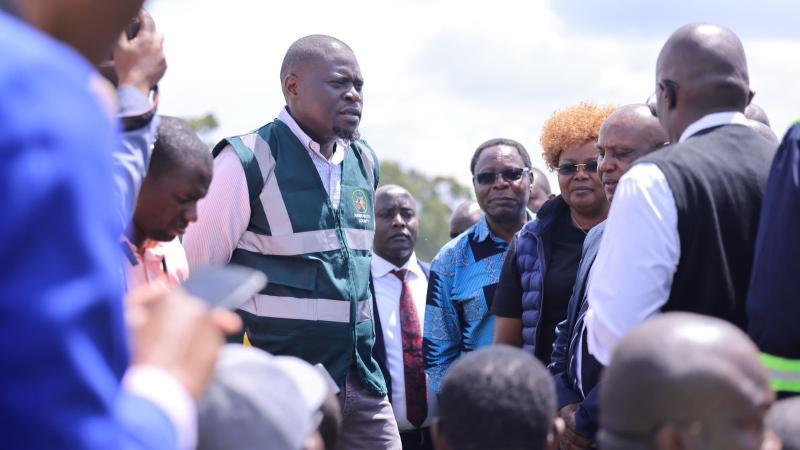
A rehabilitation of the Nairobi Dam is set to be undertaken following a joint assessment by officials from the County Government of Nairobi, the Water Resources Authority (WRA), the Nairobi Rivers Commission, the Nairobi City Water and Sewerage Company, and disaster management teams.
Speaking during a site visit on Monday, March 23, Nairobi Governor Johnson Sakaja highlighted the urgency of taking immediate action to address the deteriorating state of the dam.
"This dam has a long history, dating back to 1953. It was built not just for recreation but to manage floods for downstream areas along the Ngong and Mitumi rivers. Over the years, pollution, sewage, encroachment, and settlements have created serious risks to our people," he stated.
Sakaja outlined a three-pronged strategy aimed at restoring the dam and protecting nearby communities, including the immediate removal of debris and blockages downstream of the spillway to restore natural water flow and ease pressure on the weakened dam walls.
He added that geotechnical surveys will be conducted to assess the strength of the embankment and ensure the dam’s long-term structural integrity.
Read More
Additionally, Sakaja noted that a 30-meter protective barrier will be established around the dam to prevent encroachment, enhance public safety, and preserve the infrastructure.
Sakaja insisted that the interventions are essential not only in preventing potential flooding but also in safeguarding the environment and ensuring the safety of communities living in surrounding areas.

This came days after Sakaja ordered the immediate demolition of illegal structures along riverbanks and the relocation of individuals occupying riparian land as part of a new flood mitigation plan.
The directive was issued on Thursday, March 19, during an inspection and demolition exercise in Westlands, near the Westgate area, where Sakaja confirmed that implementation had begun following the submission of a 48-hour action report by the Infrastructure Subcommittee.
"The directive was clear: within 48 hours, we needed a concrete action plan to address flooding. I have received that report, and implementation is now underway," he said.
The operation targeted structures that had obstructed waterways, with authorities moving to dismantle developments that had reduced rivers to narrow culverts incapable of handling heavy water flow.
"Here at Westgate, an entire river had been confined to a small culvert. We are reopening it to restore proper water flow," Sakaja stated.
Heavy machinery had already been deployed across key sections to clear debris, dredge waterways, and remove illegal developments blocking natural drainage systems.
Sakaja warned that all structures built along waterways would be removed without exception and urged affected residents and developers to vacate voluntarily ahead of enforcement.
"This is not a one-off exercise. It is a sustained effort to reclaim our rivers and prevent further loss of life and property," he added.
Several areas had been earmarked for the demolitions and restoration exercise, including Kirichwa in Kilimani, parts of Westlands, sections of the central business district, and downstream zones along the Nairobi River.
In parallel, multi-agency teams were clearing blocked drainage systems and carrying out urgent road repairs in flood-affected areas, with progress reports expected on a weekly basis.
Sakaja also called for greater public accountability, blaming illegal dumping and non-compliance with approved building plans for worsening the flooding crisis.
"Approvals are granted in line with the law, but some developers deviate from approved plans. This is a shared responsibility that must be addressed," he stated.



 (1)-1791178178-md.jpg)





 (1)-1791178178-sm.jpg)