
Editor's Review
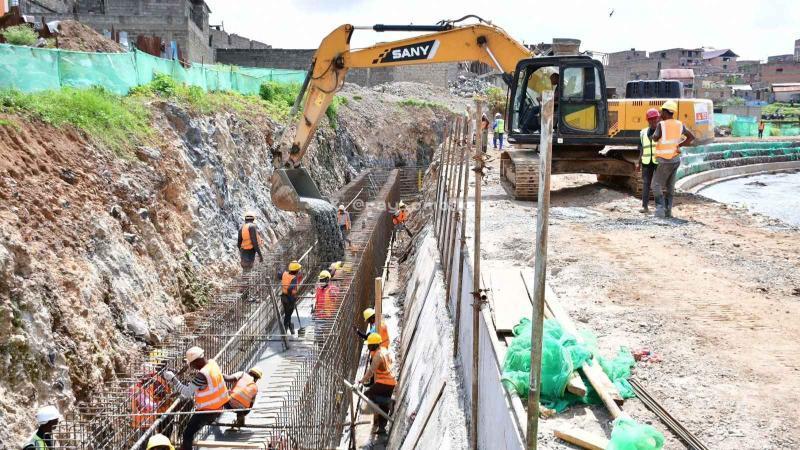
The Nairobi River Regeneration Programme is currently undertaking the construction of a modern 28-kilometre sewer system in Nairobi.
The Nairobi River Regeneration Programme is currently undertaking the construction of a modern 28-kilometre sewer system in Nairobi.
In a statement on Thursday, April 9, Interior Principal Secretary Raymond Omollo said the project aims to replace a sewer network built in 1970 that has since been overwhelmed by rapid urban growth.
He noted that the existing system can no longer cope with the demands of the expanding capital, leading to unsafe waste disposal practices among residents.
"As the City expands, the aging infrastructure can no longer meet demand, forcing many residents to resort to unsafe waste disposal into the river; an option that has exposed communities to serious health risks," he said.

Read More
Omollo explained that the government has moved to modernize the system in response to these challenges, with a new network designed to meet both current and future needs.
"In response, the Government has initiated the construction of a modern sewer network designed to match the needs of the rapidly growing capital and its surrounding regions," he added.

At the core of the project is the construction of twin trunk sewer lines stretching approximately 28 kilometres along both banks of the Nairobi River.
The new system runs from Naivasha Road to Museum Hill, cutting through areas such as Dagoretti and Chiromo via Kirichwa Kubwa, before extending to Dandora Falls.
According to Omollo, the upgraded infrastructure will significantly boost the city’s wastewater handling capacity and ease pressure on the overstretched existing network.
"Upon completion, it will handle up to 310 million litres of wastewater daily, serving areas such as Westlands, Lavington, Kangemi, Kawangware and Kikuyu, significantly easing pressure on existing infrastructure," he further said.

The sewer upgrade is also part of a broader environmental restoration strategy tied to the Climate WorX initiative, which seeks to rehabilitate the Nairobi River ecosystem.
"This effort is being implemented alongside the Climate WorX initiative, which focuses on cleaning the river, reclaiming riparian land and restoring the ecosystem through tree planting," he explained.
The project is also delivering economic benefits by creating employment opportunities for local communities, particularly the youth.
"The construction has created employment for over 1,000 people on-site, with thousands of other youth engaged in sanitation and environmental restoration, demonstrating how climate action can be effectively aligned with job creation," he concluded.

This comes days after Omollo announced that the newly completed Ngong-Suswa Highway is now fully operational.
In a statement on Monday, April 6, he said the approximately 70-kilometre tarmac road provides a critical alternative to the often congested Nairobi-Mai Mahiu Road.
Omollo outlined how the highway will ease movement across multiple counties and improve travel efficiency.
"The highway creates a direct and more efficient link from Ngong Town to Suswa, significantly reducing travel time for motorists heading to Narok, Bomet and Kisii Counties as well as other parts of the larger Western Kenya," he said.
Omollo also highlighted the economic benefits already being realized along the corridor, particularly for farmers and traders.
"The highway is already unlocking significant economic opportunities along the corridor. Farmers and livestock traders in Kajiado County now enjoy faster and more reliable access to markets in Nairobi, enabling them to move produce and livestock more efficiently while reducing transport costs," he added.
Omollo further noted that the improved accessibility is attracting new investments and boosting local economies.
"Improved accessibility has also triggered a steady rise in land value and stimulated new investments, including petrol stations, service centres, hospitality facilities and other roadside enterprises that are creating jobs and expanding local commerce," he further said.
On the broader national impact, Omollo emphasized the road’s role in easing congestion on existing routes.
"At the national level, the highway plays an important role in decongesting traffic along the Nairobi-Mai Mahiu escarpment corridor, particularly during festive seasons or in situations where the route is disrupted by accidents, landslides or floods," he concluded.
 (1)-1791708588-md.jpg)
 (1)-1791175033-md.jpg)
-1791699761-md.jpg)
-1791696120-md.jpg)

 (1)-1791708588-sm.jpg)
 (1)-1791175033-sm.jpg)

-1791699761-sm.jpg)
-1791696120-sm.jpg)