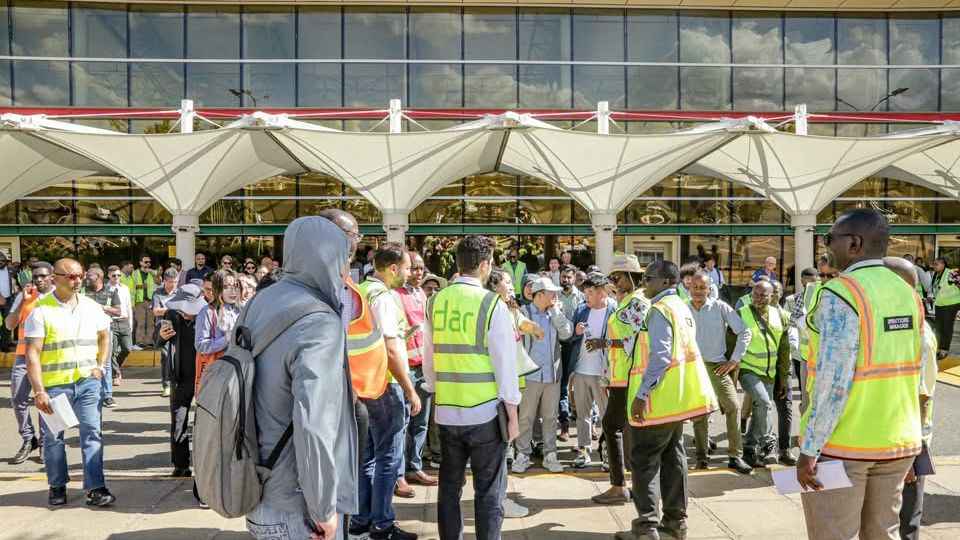
The Kenya Airports Authority (KAA) has moved a step closer to the modernization of Jomo Kenyatta International Airport (JKIA) after hosting prospective bidders for a site inspection of the airport.
In a statement on Thursday, April 9, the authority explained that the site visit allowed bidders to engage directly with the project environment and better understand the scope and expectations.
"The site visit brought together prospective bidders for an immersive, on-the-ground engagement, providing a detailed understanding of the project scope, existing infrastructure, and the areas earmarked for development," the statement read.
KAA stated that the inspection was conducted with the support of project consultants, who guided participants through the technical components of the planned works.
"The exercise was conducted with the support of DAR Al-Handasah Consultants (DAR), the project consultants, who guided participants through key technical aspects of the project," the statement added.
Read More
According to KAA, the tour covered critical airside infrastructure, giving bidders a comprehensive overview of operational and development zones within the airport.
"The tour covered key airside facilities, including the proposed location for the new terminal building and site boundaries, Runway 06/24, Aprons 1, 2 and 3, as well as Taxiways A through M. Participants also visited critical operational infrastructure such as fire stations, airside power stations, and meteorological stations," the statement further read.
The bidders extended their inspection to terminal and landside facilities, examining passenger areas, systems, and support infrastructure essential to airport operations.
KAA noted that the site visit provided bidders with valuable real-world context, enabling them to fully grasp the scale and ambition of the modernization effort.
"This hands-on experience enabled bidders to gain practical insights into JKIA’s operational environment and better appreciate the scale and ambition of the modernization project," the statement concluded.

This comes a month after the Ministry of Roads and Transport unveiled a multi-billion shilling transformation plan targeting a major upgrade and expansion of JKIA to address congestion and boost capacity.
In a statement on Tuesday, March 3, Roads and Transport Cabinet Secretary Davis Chirchir confirmed that KAA had floated a tender to construct new facilities at JKIA while upgrading existing infrastructure to meet growing demand.
Chirchir noted that the airport is currently operating beyond its intended design capacity.
According to the ministry, JKIA handled approximately 8.93 million passengers in 2025, surpassing its designed capacity of 7.5 million passengers annually.
To address the challenges, KAA finalized an Integrated Master Plan and Feasibility Study in February 2026, outlining a phased development approach.
The study recommends enhancing existing terminal and runway infrastructure to tackle short-term pressures while simultaneously expanding JKIA to accommodate long-term growth.
Comprehensive forecasts project passenger traffic rising from 8.93 million in 2025 to approximately 22.31 million by 2045, representing an average annual growth rate of 4.6 percent.
Air cargo volumes are also expected to more than double from 407,214 tons in 2025 to 860,400 tons by 2045.
In the short to medium term, the project will include upgrading the existing runway, developing a partial parallel taxiway, constructing rapid exit taxiways to improve landing efficiency, and reconfiguring passenger terminals to ease bottlenecks.
The government also plans to digitize and modernize passenger processing systems, including check-in, security screening, immigration, and baggage handling.
To meet long-term demand, KAA will develop a new passenger terminal capable of handling an additional 10 million passengers annually, with room for future expansion.
The plan also includes upgrading taxiways and aprons, expanding aircraft support facilities, modernizing air traffic control and firefighting stations, and improving cargo, maintenance, fuel, and utility infrastructure.
Landside access roads and parking facilities will also be enhanced to improve connectivity and reduce congestion.
Beyond aviation infrastructure, the government intends to establish an Airport City and Special Economic Zone (SEZ) around JKIA to unlock additional economic value.
The SEZ is designed to support export-oriented and time-sensitive industries such as air cargo logistics, agro-processing, pharmaceuticals, light manufacturing, e-commerce fulfillment, and regional distribution.
Meanwhile, the Airport City will feature business parks, corporate offices, hotels, convention and exhibition facilities, aviation support services, and mixed-use developments.
-1783697621.jpg)

-1777443173.jpg)