Editor's Review
The president said Kenya has no peer in the East Africa region, demanding that it be compared to other middle-income countries.
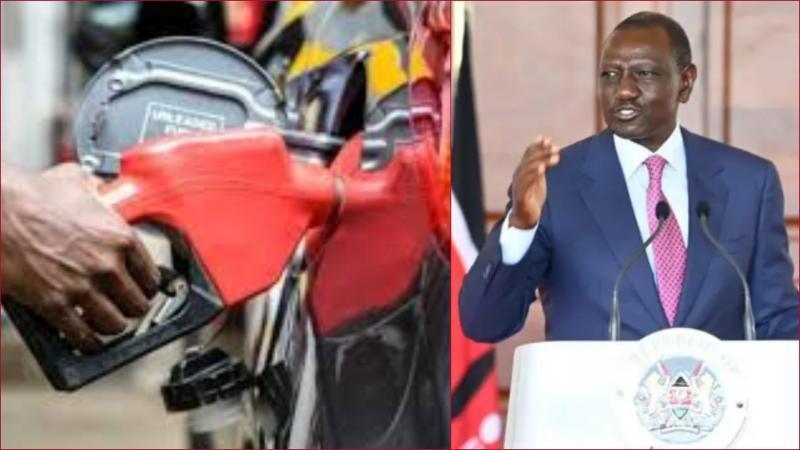
President William Ruto has sought to justify the exorbitant prices at which Kenyans purchase fuel compared to other countries within the East African region.
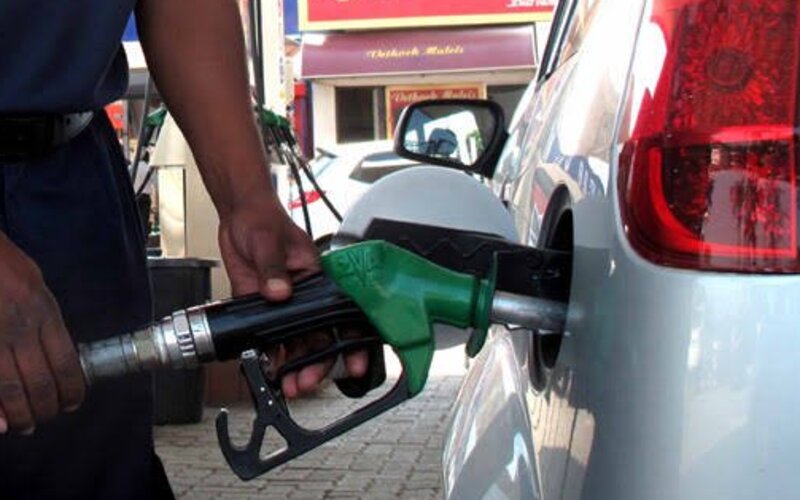
Before the government's intervention to cut the Value Added Tax (VAT) on fuel, the Energy and Petroleum Regulatory Authority (EPRA) had on April 14 upwardly revised the prices of fuel products by as much as 24.2%.
A litre of petrol was hiked by 16.1% to retail at Ksh206.97, diesel by 24.2% to retail at Ksh206.84, while kerosene remained unchanged, retailing at Ksh152.78.
With the foregoing, Kenya topped East Africa’s fuel price chart. Rwanda trailed Kenya, as petrol in Kigali cost just over Ksh203 and diesel about Ksh195.
Tanzania and Uganda were found to be cheaper, with Tanzanian fuel hovering around KSh189 for both types, while Ugandans pay roughly KSh185 for petrol and KSh174 for diesel.
Read More
Ethiopia stood out as the most affordable market, with pump prices nearly half Kenya’s levels, about Ksh109 for petrol and Ksh116 for diesel.
According to Ruto, Kenya's usage of fuel is far more complex compared to other East African nations.
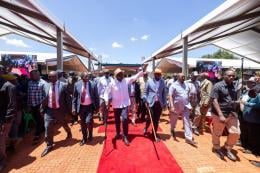
Speaking at the Karen Africa Gospel Church (AGC), Nairobi, Sunday, April 19, the president noted that Kenya ought to be compared with its peers, which cannot be found in East Africa.
"I know many people are asking why it is that sometimes the prices of fuel in Kenya are high compared to our neighbours. Kenya is a middle-income country; our neighbours are the least developed countries. There is a big difference. If you want to compare Kenya fairly with others, do it with other middle-income countries, and that is how you will get the figures right," Ruto said.
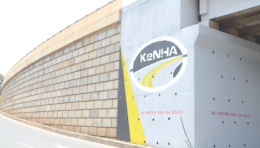
According to the president, Kenya has gone heavy on road infrastructure development, which is highly dependent on fuel.
Ruto noted that the inflated prices of fuel take care of road construction and maintenance, which is not the case in other East African nations.
The president observed that Kenya alone has a more extensive network of tarmac roads than all the East African countries combined.
"Our fuel supports transport infrastructure. I just want Kenyans to know that we have 20,000 kilometres of tarmac to maintain, and we have 6,000 kilometres of tarmac under construction. 20,000 km to maintain here in Kenya is actually the same for the other six or seven East African countries," he said.
With the foregoing, the prices of petroleum products would inevitably be higher.
"So the thousands of kilometres we have in Kenya are more than all the countries in the EAC. The 6,000 kilometres is equivalent to all the tarmacs in a neighbouring country, which has been built for 60 years. And we are setting the standards even higher, we want to have 28,000 kilometres in the next few years," the president added.
Besides Kenya's heavy infrastructural development, the president said the prices had much less to do with Kenya than the crisis in the Middle East, from which Nairobi sources its fuel.
According to the president, the crisis pitting the United States and Israel against Iran had compounded the situation by disrupting fuel supply.

 (1)-1791178178-md.jpg)
 (1)-1791178178-sm.jpg)