
Editor's Review
The Siaya senator said the harassment faced by Kenyans was unnecessary.
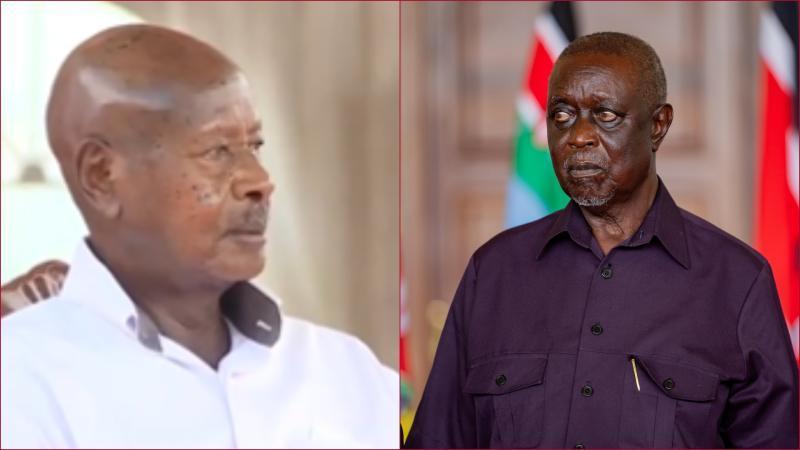
Siaya senator and ODM leader Oburu Oginga has called on President Yoweri Museveni of Uganda to ease the near takeover of the Migingo Island by the Ugandan forces.
Migingo Island in Lake Victoria has long been a source of dispute between Kenya and Uganda.
The island has experienced persistent tension as Ugandan forces sought to assert authority over the territory.
Dressed in military gear, soldiers frequently fired warning shots into the air to intimidate Kenyan fishermen and traders, driving them back indoors.
The standoff dates back to around 2004, when Uganda stationed armed police and marines on the island and hoisted its national flag.
Read More
Kenyan fishermen have consistently raised complaints of mistreatment by Ugandan security officers.
Speaking in Kisumu during the groundbreaking of Phase 2C of the Standard Gauge Railway (SGR), an event graced by Museveni, Oburu asked him to agree to having Migingo as a common base for both Kenyans and Ugandans.

Oburu expressed concerns with the apparent harassment of fishermen from both Kenya and Uganda.
He challenged Museveni and President William Ruto to devise a mechanism of cooperation which will allow a joint management of the island without conflicts.
"I appeal to you, please make Lake Victoria a common-user facility so us you can manage the security of the lake jointly with us (Kenya). We don't want harassment from our side and yours. Please make it how it used to be when our forefathers were managing it without any conflict at all," he said.
Meanwhile, speaking at the function, President Ruto noted the significance of the SGR extension, which is anticipated to go beyond Malaba border to Uganda and later to the other countries within the East and Central Africa region.
According to him, the line will integrate the region and ease trade for common good.
"Beyond Kenya and Uganda, this railway line will serve our partner States in the region, including Rwanda, Burundi, South Sudan, the Democratic Republic of Congo, and the Central African Republic. It is a powerful statement of regional integration, partnership, and shared ambition," he said.
Ruto noted that the East and Central Africa region had suffered for too long over costs and time taken to transport freight.
He said the line will solve the question of high costs of transporting goods.
"In many cases, transport and related costs account for between 30% and 40% of the final value of goods. Cargo takes, on average, 80 hours to move from Mombasa to Malaba, and more than 100 hours to reach Kampala," he noted.
He said the extended SGR will bring a modern and efficient solution to the foregoing challenge.
"We cannot build prosperity on inefficiency. That is why we must invest in modern, efficient transport and connectivity systems not only as transport corridors, but also as economic corridors," he said.
Ruto stated that the SGR will bring with it other investments aimed at benefitting those who do not undertake transport.
According to him, the line will be a passive income earner to those in the regions in passes through.
"Along this Mombasa-Malaba corridor, we will promote the development of industrial parks, logistics hubs, and commercial centres driven by private sector investment and anchored in regional integration. This is a proven model, one that has delivered rapid transformation by aligning infrastructure with industry, trade, and investment," he said.
 (1)-1791708588-md.jpg)
 (1)-1791175033-md.jpg)
-1791699761-md.jpg)
-1791696120-md.jpg)

 (1)-1791708588-sm.jpg)
 (1)-1791175033-sm.jpg)