Editor's Review
African leaders have adopted the 11-point Nairobi Declaration during the Africa Forward Summit, outlining a new framework for cooperation.
African leaders and representatives of the French government have adopted the 11-point Nairobi Declaration during the Africa Forward Summit, outlining a new framework for cooperation.
The declaration, which was adopted on Tuesday, May 12, following a two-day summit in Nairobi, commits African nations and the French government to collaboration focused on economic growth, innovation, industrialization, and strategic partnerships.
On peace and security in the continent, the African leaders backed African-led solutions to conflicts and called for stronger support for the African Union Peace and Security Architecture.
They also supported reforms to the United Nations Security Council (UNSC) to ensure greater African representation, including planning and decision- making processes and predictable and sustainable financing of AU-led operations.
“We acknowledge the evolving global security environment, its implications for Africa, and the mutually reinforcing links between peace, security, and sustainable development.
Read More
“Affirm the principles and objectives of the African Union Constitutive Act, which underscore the promotion of unity, peace, security, good governance, open and democratic elections, and cooperation among Member States,” read part of the declaration.

The leaders agreed to identify avenues for renewed cooperation to respond to emerging and transnational threats, including terrorism.
In agriculture, the summit pledged to transform the sector into a modern, competitive, and climate-resilient industry capable of driving food security, industrialization and economic growth.
The leaders are committed to promoting productive, sustainable, and resilient agriculture and food systems and investing in agricultural research, innovation, and climate-smart practices.
The declaration also emphasized the importance of building strong health systems in ensuring human security and development while advancing health sovereignty.
The African Heads of State committed to advancing Universal Health Coverage (UHC) and resilient, people-centered health systems and enhancing pandemic prevention preparedness and surveillance.
Green industrialization and energy transition formed another major part of the discussions in the Africa Forward Summit, with the leaders supporting investments in renewable energy, low-carbon systems, and flagship clean energy projects.
The leaders also agreed to expand access to clean energy, establish interconnected energy markets, and support the electrification of end-use in all relevant sectors.
The summit recognized Blue Economy as a strategic frontier for growth, jobs, and sustainability, and the leaders called for a sustainable blue economy grounded in maritime sovereignty, climate resilience, economic transformation, and inclusive prosperity.
They committed to recall the historical Africa-France partnership in maritime security, trade, and capacity building, and evolving the agreement into a forward-looking framework of reciprocity, co-investment, and shared value.
“Recall further the Africa Blue Economy Strategy, AIMS 2050, Agenda 2063, the Lomé Charter, and France's National Strategy for the Sea and Coast, we commit to African-led maritime cooperation in conformity with UNCLOS, including the Agreement on Marine Biological Diversity of Areas Beyond National Jurisdiction,” the declaration read.
On digital transformation and Artificial Intelligence, the summit committed to advancing inclusive digital transformation and responsible, safe, secure, trustworthy, and rights-respecting AI, guided by African and international frameworks.
They also agreed to mobilize public and private investment in resilient digital infrastructure and AI infrastructure and to strengthen digital sovereignty and strategic autonomy by supporting African-led ownership, hosting, processing, and value creation from data and AI systems.
Further, the African leaders called for changes to the international financial architecture, including greater African representation at the International Monetary Fund (IMF) and improved access to concessional financing for developing economies.
“We commit to work constructively towards an adequate realignment of the International Monetary Fund’s (IMF) quota shares in favor of the most underrepresented countries, to better reflect member’s relative positions in the world economy, which should reduce representation gaps, while protecting the quota shares of the poorest members, including Africa, and support efforts from countries to access concessional finance under the IMF’s Poverty reduction and growth trust and Resilience and sustainability trust,” the leaders committed.
The declaration also pushed for the recognition of African youth as a strategic asset, with the leaders committing to expand education, training, and skills development and supporting innovation eco-systems and entrepreneurship.
The leaders in attendance also reaffirm the importance of infrastructure as a driver of competitiveness and growth.
The summit agreed to invest in transport, energy, and digital infrastructure, support the implementation of the African Continental Free Trade Area (AfCFTA), and enhance regional value chains and market integration.
Additionally, the declaration emphasized the importance of mobilizing resources for transforming the continent and committed to promoting blended finance and public-private partnerships and supporting innovative financing mechanisms.
“We affirm that Africa’s future lies in building productive capacity, advancing industrialization, and fostering innovation-driven growth.
“We commit to supporting a transition from extractive economic models toward value addition, manufacturing, and sustainable production systems,” the declaration stated.
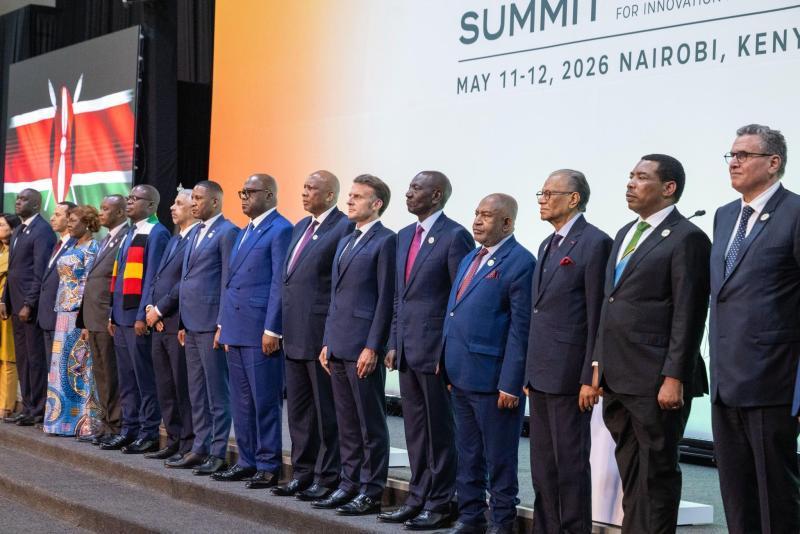
The Africa Forward Summit began on Monday, May 11, before coming to an end on Tuesday, May 12 evening.
The summit was cohosted by President Willian Ruto and his French counterpart Emmanuel Macron.
More than 30 Heads of State and over 1,500 business and economic leaders from across the continent attended the event.
Notable African leaders who were present include: Julius Maada Bio (Sierra Leone), Joseph Nyuma Boakai (Liberia), Allasane Ouattara (Côte d’Ivoire), Brice Oligui Nguema (Gabon), Bassirou Diomaye Faye (Senegal), and Bola Ahmed Tinubu (Nigeria).
Others were: Paul Kagame (Rwanda), Felix Tshesdeki (DRC), Abdel Fattah El-Sisi (Egypt), Duma Boko (Botswana), and Daniel Chapo (Mozambique).
Mauritius Prime Minister Navinchandra Ramgoolam, United Nations Secretary-General António Guterres, and Head of Government of the Kingdom of Morocco Aziz Akhannouch were also in attendance.