
Editor's Review
At the centre of the budget is the Executive, which takes up the largest share at KSh 2.817 trillion.
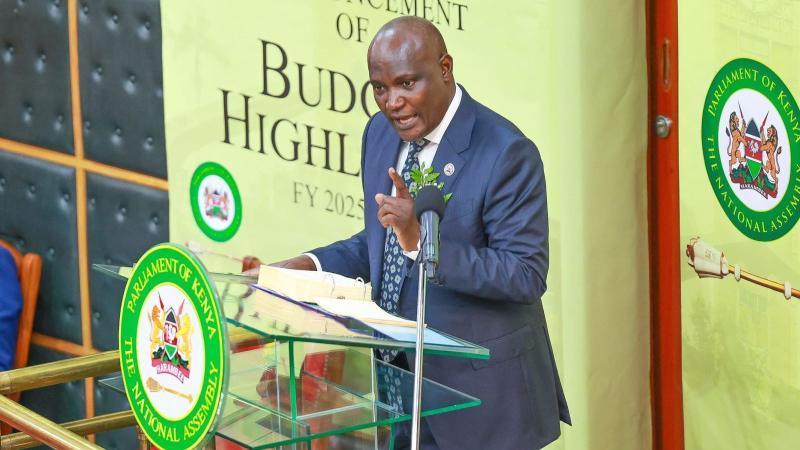
Kenya’s 2026/27 budget sets out a KSh 4.8 trillion spending plan, outlining how public resources will be distributed across government institutions and sectors.
The budget projects total revenue at KSh3.6 trillion, leaving a fiscal deficit of KSh 1.1 trillion, equivalent to 5.3 percent of GDP, while economic growth is projected at 5.0 percent.
At the centre of the budget is the Executive, which takes up the largest share at KSh 2.817 trillion. This consists of KSh 1.976 trillion in recurrent expenditure and KSh 840.6 billion in development spending.
The recurrent component covers operational costs, including wages, goods and services, while development spending is directed towards projects and capital investments.
Other arms of government account for smaller portions of the total allocation. Parliament has been allocated KSh 48.7 billion, including KSh 47.1 billion for recurrent expenditure and KSh 1.6 billion for development.
Read More
The Judiciary is allocated KSh 30.4 billion, comprising KSh 26.9 billion for recurrent expenses, KSh 2.6 billion for development, and KSh 927.4 million for the Judicial Service Commission.
A large part of government spending is tied up in fixed obligations under the Consolidated Fund Services (CFS), which has been allocated KSh 1.5 trillion.
This includes KSh 986.7 billion for domestic debt interest, KSh 267.5 billion for foreign debt interest, and KSh 247.1 billion for pensions, salaries and allowances. These are costs the government must pay, and they take up a big share of the budget.
At the devolved level, county governments are allocated KSh420 billion as an equitable share of nationally raised revenue. In addition, counties are set to receive KSh 75.5 billion in conditional and unconditional allocations, including loans and grants, bringing the total resources available to counties even higher.
Sectoral allocations show where government spending is most concentrated. The education sector receives the largest share at KSh 668.3 billion, accounting for 28.5 percent of total thematic allocations.
This is followed by national security, which is allocated KSh 566.9 billion, representing 24.2 percent of spending.

Infrastructure-related sectors also receive significant funding. Roads are allocated KSh 230.3 billion (9.8 percent), while housing and urban development and public works receive KSh 135.8 billion (5.8 percent). These allocations support construction, maintenance and expansion of infrastructure.
In the social sectors, health is allocated KSh 170.7 billion, accounting for 7.3 percent of the total.
Environmental protection, water and natural resources receive KSh 117.5 billion (5.0 percent), while equity, poverty reduction, and youth and women empowerment programmes are allocated KSh 109.7 billion (4.7 percent).
Other sectors receive smaller shares within the overall spending framework. Governance and justice are allocated KSh 84.3 billion (3.6 percent), transport receives KSh 51.8 billion (2.2 percent), while energy and petroleum is allocated KSh 27.0 billion.
Manufacturing and industrialisation receive KSh 19.2 billion, and information, communication and technology is allocated KSh 10.5 billion.
Beyond allocations, the budget outlines how the government will finance its spending. Revenue will be boosted through tax policy and administrative reforms, including simplifying tax laws, broadening the tax base, improving compliance and reducing leakages through technology.
To plug the deficit, the budget indicates the government will borrow from both domestic and external sources under the Medium-Term Debt Management Strategy, prioritising concessional loans, diversifying financing sources and issuing medium- to long-term debt instruments, while exploring innovative options.
Public debt remains at a high risk of distress, with its present value at 65.3 percent of GDP, though it is expected to decline gradually over the medium term. This will be supported by fiscal consolidation, stronger revenue mobilisation and debt management reforms.
The budget also flags risks to implementation, including droughts and floods, rising global fuel and food prices, and geopolitical tensions, particularly in the Middle East, which could affect inflation, trade and overall economic stability.
At the same time, the government is rolling out reforms to improve efficiency and transparency, including e-procurement, expansion of the Treasury Single Account, digitised payroll and pension systems, and a shift to accrual-based accounting.
As implementation begins, attention will turn to how these allocations translate into actual service delivery and project execution across sectors, and whether the planned spending will achieve its intended impact on the economy and public services.
-1792658467-md.jpg)
-1768823097-md.jpg)

-1792662527-sm.jpg)
-1792658467-sm.jpg)