
Editor's Review
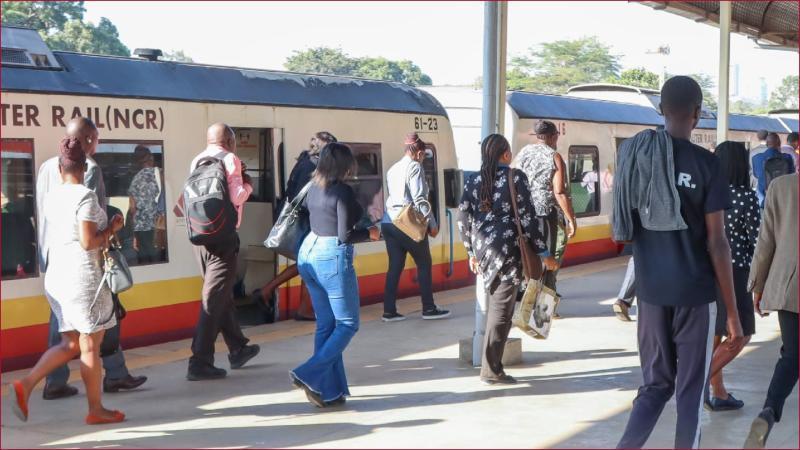
The government has unveiled plans for a transformation of Nairobi's commuter rail system through a new infrastructure programme in partnership with World Bank.
The government has unveiled plans for a transformation of Nairobi's commuter rail system through a new infrastructure programme that seeks to modernise transport services within the city and surrounding metropolitan areas.
In a notice on Tuesday, June 2, Kenya Railways said the initiative, which will be implemented through a partnership with the World Bank, forms part of the Kenya Urban Mobility Improvement Project (KUMIP).
According to the corporation, the project is expected to go beyond railway operations by also targeting urban planning, institutional reforms, and improved accessibility to transport hubs.
"The project objective is to improve urban mobility within the Nairobi Metropolitan Area and land use planning along the identified commuter corridors.
"The project will support urban policy formulation, institutional strengthening, and improvement of commuter rail services, station access roads and transit-oriented development (TOD) around railway stations," the notice read.
Read More
Among the key projects proposed under KUMIP is the development of the Nairobi Central Station-Thika commuter line alongside the electrification of the entire Nairobi commuter railway network.
The project will also include acquisition of electric and diesel-powered trainsets, development of maintenance workshops, construction of station access roads, expansion of multi-modal transport connections, and establishment of manufacturing facilities for railway spare parts and concrete sleepers.
Other planned developments include construction of the Likoni Road over Railway Bridge and the acquisition of railway maintenance rolling stock, including locomotives, hopper wagons, and low loaders.
Kenya Railways says the implementation process will involve collaboration with multiple institutions and county governments within the Nairobi Metropolitan Area.
"Kenya Railways Corporation in conjunction with other implementing agencies and County Governments within the Nairobi Metropolitan Area will spearhead the implementation of the project activities," the statement added.
The corporation also confirmed that procurement processes for the project will follow World Bank guidelines.
"The procurement of the project activities will follow the World Bank Procurement Regulations for Investment Projects Financing (IPF) Borrowers," the statement further read.

As part of preparations, Kenya Railways announced plans to engage industry stakeholders and private sector players through a consultative meeting scheduled for later this month.
"To this end, Kenya Railways Corporation hereby invites interested private sector stakeholders and industry players to a consultative meeting on June 24 2026 at Kallway Training Institute, South B, Nairobi from 0900am to 1300hrs Eastern African Time (EAT)," the notice stated.
According to the notice, the meeting will be used to share project details with potential vendors, gather feedback on procurement approaches, understand market conditions, examine pricing trends, and assess available technologies and supply chain risks.
The consultation will also function as a market sounding exercise intended to inform the development of the project procurement strategy before implementation begins.
Kenya Railways has urged stakeholders to actively participate in the process.
"Stakeholders are strongly encouraged to participate in this process and to use the meeting as an opportunity to ask questions and provide comments regarding this upcoming project procurement opportunity," the notice concluded.
Elsewhere, the historic Nyahururu Safari Train has returned to service, marking the revival of the iconic Thomson’s Falls Rail after 46 years.
In an update on Monday, June 1, Kenya Railways said the restored railway line reconnects Nairobi, Gilgil, Ol Kalou and Nyahururu.
"After 46 years, the iconic Thomson’s Falls Rail is back on track, reconnecting Nairobi, Gilgil, Ol Kalou and Nyahururu through the scenic Nyahururu Safari Train," the corporation said.
The revived service is expected to improve connectivity between the four towns while also boosting domestic tourism.
"Experience a journey through the heart of Kenya aboard a safe, comfortable and affordable rail service that blends history, adventure, and convenience. Rediscover the charm of rail travel and explore the beauty of the Aberdare region like never before," the corporation added.
According to Kenya Railways, passengers can choose between first class and economy class travel.
A first-class ticket from Nairobi to Nyahururu costs Ksh1,300, while an economy class ticket costs Ksh600.
Travelers heading from Nairobi to Gilgil will pay Ksh960 in First Class and Ksh450 in Economy Class.
Those traveling between Nairobi and Ol Kalou will pay KSh1,160 in First Class and KSh550 in Economy Class.
For shorter journeys, fares between Gilgil and Ol Kalou are set at KSh200 in First Class and KSh100 in Economy Class, while travel between Gilgil and Nyahururu costs KSh350 and KSh150 respectively.
Passengers traveling between Ol Kalou and Nyahururu will pay Ksh150 in First Class and Ksh50 in Economy Class.
The Nyahururu Safari Train will operate from Nairobi to Nyahururu every Tuesday and Friday.
The train will depart Nairobi at 10:00 a.m., arrive in Gilgil at 2:00 p.m., before departing at 2:15 p.m., reach Ol Kalou at 4:15 p.m., and leave at 4:20 p.m., before arriving in Nyahururu at 5:50 p.m.
For the return journey, the train will operate from Nyahururu to Nairobi every Wednesday and Sunday.
It will depart Nyahururu at 10:00 a.m., arrive in Ol Kalou at 11:30 a.m., and depart five minutes later, reach Gilgil at 1:35 p.m., and leave at 1:50 p.m., before arriving in Nairobi at 5:50 p.m.
-1768823097-md.jpg)


 (1)-1792651348-sm.jpg)