Editor's Review
Ruto said the law will provide the legal and financial framework needed to support the government's transformation agenda.
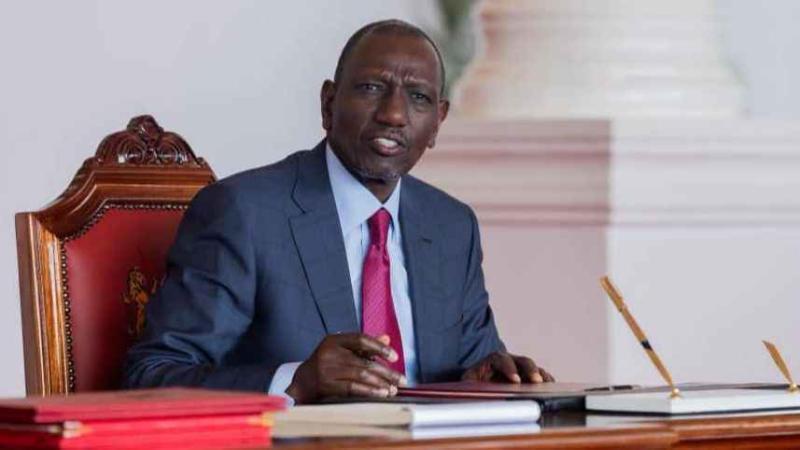
President William Ruto has signed the Finance Bill, 2026, and the Appropriation Bill, 2026, into law, paving the way for the implementation of the government's budget and development agenda for the next financial year.
In a statement on Tuesday, June 23, Ruto said the two laws will provide the legal and financial framework needed to support the government's transformation agenda, job creation efforts, and investments in key sectors of the economy.
"Assented to the Finance Bill, 2026, and the Appropriation Bill, 2026, which provide the legal framework and resources required to finance our transformation priorities, create jobs, strengthen livelihoods, and invest in the future," he announced.
Ruto emphasized that the Finance Act, 2026, does not introduce new taxes but instead seeks to enhance tax administration and compliance.
"The Finance Act, 2026, does not raise taxes. Instead, it improves fairness by strengthening compliance, closing loopholes, and ensuring that every individual and business pays what is lawfully due," he said.
Read More
Ruto added that the government is targeting tax evasion and revenue leakages rather than increasing the burden on ordinary citizens and businesses.
"We are pursuing tax avoidance, not taxpayers; offshore schemes, not ordinary wages; and leakages, not livelihoods," he added.
Ruto also dismissed claims that the new law introduces taxes on several commonly discussed items and services, saying such reports are inaccurate.
"Contrary to misinformation, there are no taxes on freehold land, no taxes on mitumba, no changes to rental income tax, no tax on bottled water, no new tax on M-PESA or mobile money transactions, no new tax on mobile airtime or data, and no new tax on locally manufactured packaging for essential products," he further said.

Ruto further highlighted the government's spending priorities, noting that education, health, and agriculture have received increased allocations under the 2026 budget.
"Our budget invests in people, productivity, and prosperity. Education has received the highest allocation at KSh784 billion, up from KSh526 billion in 2022. Funding for health has increased from KSh132 billion to KSh175 billion. Agriculture has risen from KSh44 billion to KSh63 billion," he noted.
Ruto also announced measures aimed at shielding consumers from volatile fuel prices, including the allocation of funds for fuel stabilization.
"To cushion Kenyans against fluctuations in fuel prices, KSh21.5 billion has been set aside for fuel stabilisation, among other key interventions," he explained.
Elsewhere, this comes days after National Assembly Majority Leader Kimani Ichung'wah dismissed claims that he was in contact with Ruto as legislators debated the Bill.
In a video that went viral on social media, Tetu MP Geoffrey Wandeto was making his submissions when the Majority Leader was heard mentioning names in the background.
The purveyors of the viral clip concluded that the Kikuyu MP was updating Ruto on the goings-on in the chambers, insinuating the executive had a hand in the passing of the Bill.
However, seeking to clarify things, Ichung'wah said he was referring to Kesses MP Julius Rutto, a member of the Committee on Finance and National Planning.
He said the president was not to be consulted in any form, calling out those he said are propagandists advancing an opposition campaign.
"The Desperado propagandists don’t even understand that, as the leader of my team in parliament, I have the liberty to advise which of my team members can speak to a bill.
"Hon. CPA Julius Rutto, Member for Kesses, is a star Finance committee member, now their propaganda queen only hears 'na umpee CPA Ruto' and selectively refuses to hear 'na Wamuchomba pia'," Ichung'wah said.


-1792658467-md.jpg)
-1768823097-md.jpg)