Editor's Review
The Ministry of Treasury has projected up to Ksh371 billion in oil revenue as Parliament reviews the proposed Field Development Plan (FDP) also expected to create more than 3,000 jobs.
The Ministry of Treasury has projected up to Ksh371 billion in oil revenue as Parliament reviews the proposed Field Development Plan (FDP) for Blocks T6 and T7, with the project also expected to create more than 3,000 jobs.
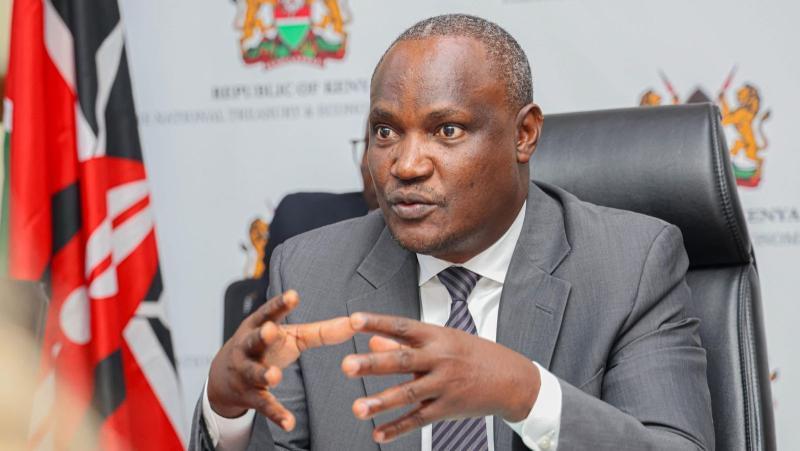
Appearing before the National Assembly Departmental Committee on Energy and the Senate Standing Committee on Energy on Tuesday, February 16, National Treasury Cabinet Secretary John Mbadi defended the foundations of the oil development plan spearheaded by the Ministry of Energy and Petroleum.
Mbadi assured lawmakers that the project would not expose Kenya to public debt obligations under the Production Sharing Contract (PSC) framework.
“The FDP does not create any explicit or implicit public debt obligation for the Government. The financing of exploration, development and production remains solely the responsibility of the contractor under the PSC framework," he told lawmakers.
According to Mbadi, the Treasury projects that Kenya could earn between $1.05 billion (Ksh136 billion) at $60 per barrel and $2.9 billion (Ksh371 billion) at $70 per barrel over the life of the project.
Read More
Direct revenues are expected from profit oil splits and government participation, while indirect revenues will benefit key state agencies.
Kenya Pipeline Refinery Limited (KPRL) is projected to earn Ksh42.3 billion in storage and handling fees, while the Kenya Ports Authority (KPA) could generate Ksh41.9 billion from the New Kipevu Oil Jetty.
In addition, Mbadi said the project is estimated to generate over 3,000 direct, indirect and induced jobs, boosting PAYE collections and social security contributions.
"Oil revenues are expected to positively contribute to GDP growth through upstream, midstream and associated economic activities," he said.
Treasury disclosed that contractors have sought fiscal concessions amounting to $1.331 billion (Ksh173 billion) under Project Specific Fiscal Terms (PSFTs).
At a base oil price of $60 per barrel, Government net cash flow would decline from $3.485 billion under existing PSC terms to $1.047 billion if all tax requests and harmonisation adjustments were granted.
Conversely, the contractor’s net free cash flow would shift from negative territory to a projected $497 million.
However, Mbadi stressed that any tax waivers must comply with the Constitution.
"Article 210 of the Constitution provides that no tax or licensing fee may be waived, varied or exempted except as provided by legislation," he noted.

Mbadi said should the Government exercise its 20 percent back-in rights, it would contribute approximately $1.228 billion through the normal approval process.
Government-funded enablers, including land, power, water, roads and crude oil handling infrastructure, are estimated at $433.4 million (Ksh56.3 billion) and are either budgeted for or at planning and feasibility stages.
On crude transportation, Mbadi backed a phased approach, beginning with trucking as an interim measure before transitioning to rail transport for efficiency and cost control.
"This phased approach ensures logistics arrangements are matched to production levels while protecting Kenya’s share of oil revenue from excessive transportation costs," he stated.
The projected decommissioning cost of $331.8 million, plus associated interest, will be managed through a Decommissioning Fund as provided under the Petroleum Act, with contractors required to provide financial guarantees.
"This approach aligns with international best practice and ensures that adequate resources are set aside to meet end-of-life obligations," he assured.
This comes barely a day after the government announced a renewed push to strengthen its anti-money laundering systems as it seeks to restore international confidence in the country’s financial sector.
In a statement on Monday, February 16, Treasury Principal Secretary Chris Kiptoo outlined the progress made so far and the next steps required for Kenya to meet international standards set by global financial oversight bodies.
"Kenya is accelerating reforms to strengthen its Anti-Money Laundering and Combating the Financing of Terrorism (AML/CFT) framework to address identified gaps and restore full international confidence in the country’s financial system," he said.
Kiptoo said discussions had been held to evaluate ongoing efforts and align strategies aimed at meeting international requirements for removal from the monitoring process.
"On behalf of Hon. John Mbadi, Cabinet Secretary, The National Treasury, I held a meeting with Principals of AML/CFT implementing agencies to review progress under the International Cooperation Review Group (ICRG) process and agree on the next steps toward exiting the grey list," he added.
According to the Treasury, several legal and institutional milestones have already been achieved as part of the reform agenda.
These include new legislation, stronger coordination mechanisms, and tighter oversight standards intended to improve transparency and reporting across the financial sector.
"Key progress includes the enactment of the Anti Money Laundering and Combating of Terrorism Financing Laws (Amendment) Act, 2025, and the Virtual Asset Service Providers (VASPs) Act, 2025, strengthened institutional coordination, enhanced risk based customer due diligence, improved suspicious transaction reporting, and closer inter agency collaboration across critical sectors," he further said.


 (1)-1788411142-md.jpg)