
Editor's Review
Padre Watenga's ministry deliberately meets people where they are rather than waiting for them in traditional religious spaces.
Anglican Church of Kenya (ACK) Priest Padre Michael Watenga, popularly known as Padre wa Wote, was one of the most talked-about religious figures in Kenya in 2025, not because of traditional pulpit sermons, but his growing practice of ministering in nightclubs and entertainment venues.
His unconventional approach has drawn thousands of views online, elicited widespread reaction on social media, and expanded his ministry into spaces often seen as far removed from conventional church settings.
Padre Watenga, who serves in the Diocese of Kitale under the Anglican Church of Kenya, has leveraged his sizeable online following, including tens of thousands of followers on TikTok, to reach audiences beyond the walls of formal church services.
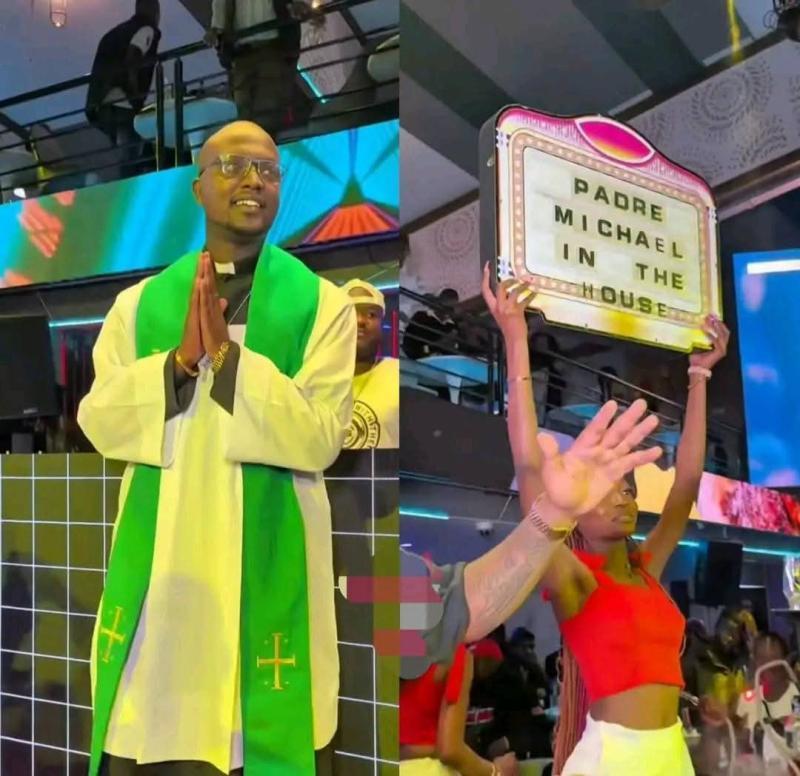
In numerous viral videos, he appears in full clerical attire inside nightclubs, greeting revellers, sharing brief messages of faith, and offering prayer.
One of the most notable moments in Watenga’s emerging nightclub ministry occurred at Timba XO, a popular entertainment venue in Eldoret. In footage widely shared online, the priest enters the club dressed in his traditional white and black cassock with a green scarf, greeted with a banner declaring, “Padre Michael in the house.”

Amid pulsing music and cheering patrons, Watenga mingled with guests and even collected what appeared to be an offering, a spectacle that blurred the lines between worship and night entertainment.
During the visit, a well-known Catholic hymn, “Uninyunyuzie maji” by the Our Lady of Fatima Kongowea choir, was played, creating an unusual soundscape of faith and dance. The video quickly spread across social platforms, with many users reacting with amusement, surprise, and admiration at the sight of a priest in a club setting.
Similarly, another viral clip from an Eldoret–Nakuru highway club shows Watenga entering a crowded nightclub flanked by hostesses, with patrons momentarily pausing their festivities as he took centre stage to deliver a spiritual message.
These scenes have become a signature element of his ministry, drawing attention to a form of outreach that deliberately meets people where they are rather than waiting for them in traditional religious spaces.

Padre Watenga believes many people found in nightlife environments are searching for connection, acceptance, peace, or healing, not necessarily because they are “lost” in a moral sense.
In posts shared on his social media, he has criticised what he sees as judgmental attitudes within some church communities and stressed that his ministry is about listening, loving, and praying rather than condemning.
In one candid social media message, Watenga emphasised he seeks to reach individuals who feel rejected whether by family, church, or society, asserting that clubs can become spaces where people feel free to express themselves without fear of judgment.
He recounted praying with a young waiter who approached him outside a nightclub, underscoring his belief that ministry should meet people “exactly where they are.”
The priest has previously shared that he received invitations from several Kenyan towns, including Kisii, Mombasa, Kisumu, and Nakuru, though he noted practical requirements such as fuel, accommodation, and security would determine his ability to attend those events.
Kenyans have responded with humour and admiration, praising Watenga’s boldness and willingness to bring spiritual messages to unconventional spaces.
Some commenters have said his work reflects a modern interpretation of ministry that meets people in their everyday lives, while others have expressed discomfort or disapproval, questioning the appropriateness of a cleric in nightlife environments.
Despite differing opinions, Padre Watenga’s presence in clubs has undeniably made waves, prompting national conversation on how faith and spirituality intersect with everyday life, secular spaces, and modern cultural dynamics.
-1789385357-md.jpeg)




 (1)-1791708588-sm.jpg)
 (1)-1791175033-sm.jpg)
-1791699761-sm.jpg)