Editor's Review
The International Monetary Fund (IMF) has weighed in on Kenya’s recent decision to cut Value Added Tax (VAT) from 13% to 8%.
The International Monetary Fund (IMF) has weighed in on Kenya’s recent decision to cut Value Added Tax (VAT) from 13% to 8%.
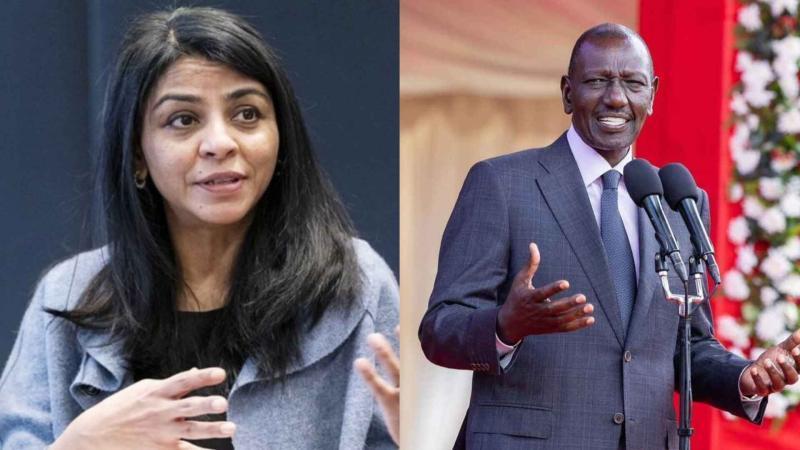
Speaking at the IMF Spring Meetings in Washington, D.C., IMF Deputy Director of the Fiscal Affairs Department Era Dabla-Norris indicated that countries worldwide are adopting varied fiscal strategies, including tax cuts and spending adjustments, to cushion their economies.
According to Dabla-Norris, the IMF is closely monitoring how governments are reacting to the current economic climate.
"We are tracking what countries are doing around the world, and we're doing this in a very comprehensive way. We're looking at the types of measures that countries have put in place. And what we see is that countries are really adopting a wide range of measures.
"Some are adopting revenue-based measures, so cuts in VAT or excises. Others are doing spending-based measures, yet others are doing pricing measures," she said.
Read More
The IMF cautioned that it is still too early to fully assess the financial implications of these measures, noting that governments appear to be acting cautiously compared to previous global economic shocks.
"While it's too early to determine what the fiscal costs of these measures are, what is becoming clear is that the response so far has been much more restrained than, say, the 2022 shock, the energy price shock," she added.
Dabla-Norris further pointed to uncertainty in the global economic outlook as a key factor behind the cautious approach, with many countries avoiding large-scale intervention packages for now.
"And part of it is because it's not entirely clear. There's a lot of uncertainty as to how long the situation will last, so countries are not necessarily coming out in full force with huge packages," she further said.

Notably, this development comes barely a day after the Energy and Petroleum Regulatory Authority (EPRA) announced revised retail fuel prices following a change in VAT.
In a statement on Wednesday, April 15, EPRA said the new pricing will apply from April 16 to May 14, 2026.
In the latest review, pump prices for Super Petrol and Diesel in Nairobi have decreased by Ksh9.37 and Ksh10.21 per litre respectively.
As such, super petrol, diesel and kerosene now retail at Ksh197.60, Ksh196.63 and Ksh152.78 respectively in Nairobi.
"The pump price per litre in Nairobi of Super Petrol and Diesel decreases by Ksh9.37/litre and Ksh10.21/litre respectively while that of Kerosene remains unchanged.
"Consequently, the level of subsidy on Kerosene reduces from the current Ksh108.10/litre to Ksh96.56/litre," the statement read in part.
The opposition, led by Former Deputy President Rigathi Gachagua, had issued a warning to Ruto, threatening nationwide mass action if urgent measures were not taken to address the rising cost of fuel.
Speaking during a press briefing, Gachagua, on behalf of the opposition coalition, gave the government a seven-day ultimatum to act on a series of demands aimed at reducing fuel prices and addressing what he described as a worsening fuel crisis.
The opposition called for the immediate convening of a special sitting of the National Assembly to debate the controversial government-to-government (G-to-G) fuel import arrangement, which they blame for the recent surge in pump prices.
"President William Ruto, you must immediately instruct the National Assembly speaker to convene a special sitting to scrap G-to-G," Gachagua stated.
Gachagua and his allies further outlined several measures they believe would help ease the financial burden on Kenyans, including scrapping the G-to-G fuel import deal.
Others were reducing or removing fuel-related taxes such as VAT and the road maintenance levy, suspending the Affordable Housing Levy and NSSF deductions, and redirecting funds from major government projects to cushion consumers.
The opposition argued that these steps are necessary following the latest fuel price review by the Energy and Petroleum Regulatory Authority, which pushed petrol and diesel prices above Ksh200 per litre.
Gachagua warned that failure by the government to act within the given timeline would trigger nationwide protests across the country.
"If there is no action taken on the part of William Ruto, we shall announce further measures to the people of Kenya to force William Ruto and the National Assembly to act in the best interest of the people of Kenya," the United Opposition warned.